Wednesday, February 20, 2019

Destinations for MLBTradeRumor's Forgotten Free Agents

So today MLBtradeRumors put up a post of 10 Forgotten Free Agents who may still provide some solid value for teams. As I read them, I immediately had some ideas as to where some of them could go, so I thought I'd throw my ideas out there. Disclaimer: I looked at my top 50 free agent predictions this morning, and so far I've only gotten one right (Joe Kelly to the Dodgers), so given that track record I'll be lucky to be half right on one player. How can you be "half right" you ask? Well I could pick the right city but wrong team (like New York Yankees instead of Mets).

Jose Iglesias: Yankees. Speaking of the Bronx Bombers, here is my first match. The Yankees are planning on giving the starting SS gig to Troy Tulowitzky, at least until Didi Gregorious can return midseason from his injury. In general I like the plan because Didi has been a great Yankee and Tulo for the league minimum (and off of Turf again) at least should provide solid production with some upside. But given Tulo's own injury risk, and the uncertainty of how Didi will return from the DL (sorry MLB, it is still the DL to me), they would be wise to stack some depth there. Iglesias would provide glove value not offensive value, but for this team that may be all they need, and the good thing is that gives him a high floor, which is what they should get. Preseason I picked Orioles, where he still stands to be an upgrade.

Ervin Santana: Padres. The Pads just made the big waves with the $300mm signing of Manny Machado. Given that he's likely to give the most value on the first 3-4 years of that deal they should be pushing hard to improve and I think Santana may be one of the best bargains available on the market because he has some of the largest bounce-back potential given that his value is down primarily from an injury (and ineffectiveness likely tied to that injury). Given the years of strong performances that preceded it there is more reason to believe he can bounce back than say...Troy Tulowitzky. The Pads clearly need to improve in their pitching, and given their ballpark that should be the easier thing to improve. In my preseason prediction for him I listed the Mariners which still also seems reasonable but given their soft-rebuild they seem to need him less.

Denard Span: Reds. I have to applaud the Reds for their offseason. I still think they are the bottom dwellers of this division, but not by much (the NLC and NLE look to be fun division races this year). Since there really were no good moves to further tank/rebuild, they opted to push towards competitiveness. But since they let Billy Hamilton go their CF situation is not as reliable (Billy may not have been great with the bat, but you knew what to expect from him overall as a player). Span would be a great 4th OF. He measured out well as a hitter and runner last year, and while his defense is not what it used to be he could still probably fake it in CF if they need to. And let's not forget this team is considering putting Matt Kemp in OF, so....

Logan Morrison: Rockies. Whereas a guy like Iglesias has a high floor and low ceiling, LoMo is more the opposite. And in the last two years we've seen how high his ceiling can be and how low his floor really is. Now the Rockies did add Daniel Murphy with the idea he'd be playing a lot of 1B, but Morrison might just crush it in Colorado. The guy is one year removed from a massive offensive outburst and his ISO and BABIP last year both suggest he could possibly perform at that level again. He's not likely going to cost much either. I say put him at 1B and Murphy at 2B. You can do late game defensive shifts or move Murph back over if LoMo doesn't pan out. But the Rockies have had a revolving door at 1B for some time with surprisingly little results it seems. This just seems like a low cost risk worth taking. The original intent to play Murphy out of his natural position (which has no clear-cut replacement as-is) is what makes this such a good move. If it doesn't pan out plan B is their current plan A, but if it does they are a much better team.

Image result for carlos gomez brewersCarlos Gomez: Brewers. This is a pure depth move and may not be the best chance for Go-Go. Teams like the Giants and Orioles strike me as possibilities there, and like LoMo, his track record was better than his previous season so someone may believe in him enough to give him a legit shot at starting. The reason I like the Brewers for him is two-fold: The Brewers have traded away a lot of their OF depth this season, sending Domingo Santana to Seattle (where I think he will do well) and Keon Broxton to the Mets (where I'm less bullish on his outlook given the fact they already have a great defensive-RHH CF in Lagares). While Ben Gamel looks to be the 4th OF, and guys like Perez can handle OF, there are no clear guys to come up in the event of an injury, and having Gomez's upside in their depth would be good for a team looking to compete in a tough division. For Gomez the reason would be he was at his best in Milwaukee. Fans loved him (some wild swings and inability to hit cut-off men aside) and he has not performed at the level he did when he was here, so I'm banking a bit on the comfort factor perhaps coming into play. Don't forget that he liked it here so much he signed a very team friendly extension to stay (and that's with his agent Scott Boras likely counseling against it).

James Shields: Athletics. The A's somehow were a great team with a terrible rotation last year. Terrible on paper at least. This year they still need to cobble together some semblance of a rotation. With Shields they are likely going to get innings, not quality innings. But really, that may be important for them at this stage. They have a lot of guys who will be coming back at some point from injury, best not to put too many innings on those arms. Shields can be our modern day Livan Hernandez. Nothing fancy or special, but somehow good for 180-200IP. I would think moving to that spacious stadium might be helpful too.

Hanley Ramirez: Unemployment. This guy was available for a box of cracker jacks last year and no one bit. Now he is a year older and a year less likelky to produce at his past herculean levels. He probably should be worth a minor league invite, but I am not convinced he will get one. I predict independent league ball for him, and least for starters. If he does well, that + his solid dominican league play + an injury or grave underperformance might = a midseason contract.

Jose Bautista: Indians. Cleveland has done nothing to improve its outfield this offseason and generally have put their foot to the breaks, focusing more on decreasing spending. Lucky for them Jose shouldn't cost much of anything. He is defensively limited, and his bat is diminished. He likely won't hit for much average. But he walks and still has some pop, which is great for an outfield that seems to lack certainty in those two areas. He's a role player for them, but one who could help keep this outfield from killing much needed late-inning rallies for the Indians. While they are the clear favorites in the division, their offseason (mixed with real chances for improved results from the Royals, Twins, or White Sox) and the gap may not be as wide as it first appears.

Matt Holliday: Braves. The Nick Markakis signing really inspired no one, expect maybe the Markakis family. Some outfield depth would be wise for a team that made a quick splash with the Josh Donaldson signing (which I love for them btw), and then has had an underwhelming offseason. Holliday could be like this year's Jose Bautista for them. A solid veteran who comes up when they need him most and then is cut loose when they don't need him anymore. But if they guy can get on base at a crazy clip again, he - like Bautista before him - will be a valuable bat off the bench.

Tyler Clippard: Red Sox. Any reader of MLBTradeRumors.com have seen the criticism the Sox received for essentially letting their bullpen suffer loses to free agency with no relief. And any reader would also know that cost is a major factor because of where the Red Sox are in regards to spending and luxury tax (funny no one ever calls them the "evil empire" now that they have been top spenders and one of the 21st century's winning-est ball clubs). This puts them in a position to really likely go with what they got, at least for now. As the chats on traderumors puts it: they have a reasonable shot at a wild card at least if not the division as they are currently constructed, so start the season seeing what you got and react accordingly. It's not a terrible plan, but if a quality, experienced, late-inning arm is available at an affordable rate (as I suspect he will be at this stage) then they should add him. Bullpens are volatile, more than anything else in this game. Therefore you need to stack them with depth and guys with long history of bullpen success are a wise addition.
*Note: Shortly after publishing this I see Clippard signed with the Indians. My terrible choices continue...

Wednesday, January 23, 2019

From Constance to Worms: Hus & Luther

"Today you roast a goose, but you will hear a swan rise from the ashes whom you will be unable to roast."
-Jan Hus

The above quote is unlikely to be authentic from Hus, if for no other reason one only need look at the various versions of it out there (and especially the ones that give a date of "a hundred years from now" after the word "but"), but its attribution is nonetheless important as it has long been used (by those who believe it to be true or those who doubt its authenticity) to draw a connection between the Czech Reformer and the German Reformer Martin Luther, who just over a hundred years later posted the 95 Theses upon the doors of the Castle Church in Wittenberg.
This picture depicts Hus (right) and Luther (left) together serving communion in both kinds - a common point between their individual reformations.
Last year when teaching for my local synod's school of theology a class on the Reformation, I found myself reading quite a bit about the Council of Constance, which was a significant moment in studies of Reformation History for both its role in the rise of concilliarism (the laying of ultimate church authority upon a council) and the execution of one of the single most prominent reformers of the church prior to the period of Reformation that came with Martin Luther: Jan Hus (often put as John Huss in English). As I read a detailed accounting of the council (particularly from History of the Christian Church Vol VI by Schaff) I remember being struck by how many similarities existed between Hus' trial and that of Luther at the Diet of Worms. And today felt it might be a nice day to share some of those commonalities.

It should also be noted that Luther himself had exposure to Hus' works and had carefully examined the decrees of church councils, especially in advance of and in the aftermath from the Leipzig debate of 1519 where he and Johann Eck debated the topic of church (and especially Papal) authority. There Hus was directly cited and used by Eck to decry Luther's teachings and Luther (after examining some of Hus' teachings that were condemned) claimed the church may have wrongly charged him a heretic. The next year in his Address to the German Nobility he outright stated :
"...we must honestly confess the truth and stop justifying ourselves. We must admit to the Bohemians that John Hus and Jerome of Prague were burned at Constance against the papal, Christian, imperial oath, and promise of safe-conduct...Second, the emperor and princes should send a few really upright and sensible bishops and scholars [to the Bohemians]. On no account should they send a cardinal or a papal legate or inquisitor, for such people are most unversed in Christian things. They do not seek the salvation of souls, but, like all the pope's henchmen, only their own power, profit, and prestige. In fact, these very people were the chief actors in this miserable business at Constance." 
These words suggest that Luther has some knowledge of the events of the Council of Constance. They are significant to me, because they cause me to wonder if (and this is something I have never heard any scholar suggest or reflect upon) Luther's words at the Diet of Worms were drawn from his knowledge of the Hus' words at the Council of Constance, especially since we also know Luther came to hold Hus in high esteem as a Christian, saying at one point that if Hus "is to be regarded as a heretic, then no person under the sun can be looked upon as a true Christian."
Related image
Luther before the Emperor Charles V at the Diet of Worms
Let's begin with Luther. Expecting an opportunity to speak before the emperor he was met instead with two questions that were to be answered in the affirmative or negative (yes or no): was the pile of books on the table before him his (to which his lawyer asked the names of those books to be read aloud) and would he recant of their errors, which had already been judged? To the first question he answered in the affirmative, and indicated he had written more than what was laid out on the table. He asked for time to consider the second question since it touches God, the Word, and salvation. Following a one day reprieve he then gave his reply. It was roughly a 10-minute speech (first given in German, then repeated in Latin), during which he was being pressed for a simple answer. He divided his works into three parts: the first laying out clear and plain Christian truths that even opponents embraced, and he certainly could not recant those. The second were directed against the errors of the pope and papacy, which he again could not recant for fear of encouraging such tyranny. The last portion were directed at his opponents and there he confessed of speaking too harshly, but he could not recant the works themselves because these individuals were defending the pope's tyranny. In the end he was reminded that he had not answered the question clearly laid before him, and he was to give a simple answer. It is at this time that we come of the point of Luther's trial at Worms that many know and which I see as having some direct connections to Hus. Luther replies:
Since then your serene majesty and your lordships seek a simple answer, I will give it in this manner, neither horned nor toothed: Unless I am convinced by the testimony of the Scriptures or by clear reason (for I do not trust either in the pope or in councils alone, since it is well known that they have often erred and contradicted themselves), I am bound by the Scriptures I have quoted and my conscience is captive to the Word of God. I cannot and I will not retract anything, since it is neither safe nor right to go against conscience. I cannot do otherwise, here I stand, may God help me, amen.
While most assume that was the end of the diet, or at least Luther's part in it, that was not quite accurate. Though it was hardly as dramatic as the formal hearing or the shouts of "long live Luther" coupled with "to the fire with him" by opposing camps, for days after various dignitaries met with Luther to try to dissuade him from his position. It was only after it was clear all that would not dissuade him and the Emperor Charles gave him permission to leave, choosing to honor the safe-conduct promise he made, that Luther departed.

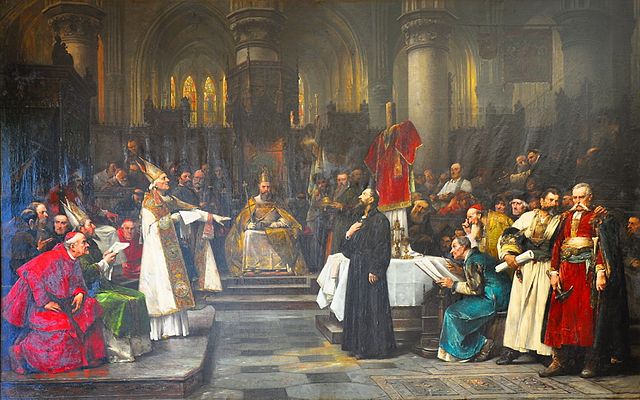
Now lets look at Hus. His time in Constance lasted months as opposed to days, however his replies at certain moments are significant as we look at Luther's. Hus was invited to the Council by the "King of the Romans" Sigismund under a promise of safe conduct to confess his faith and teachings before the council for examination. Much like Luther, he was warned by friends not to go but answered the summons in full realization it may cost him his life. He spent a good deal of the time imprisoned after he was accused of attempting to flee (what many scholars argue was a superfluous charge), first in the dungeon of a convent, later in a bishop's castle. Unlike Luther, he was not granted an advocate for his hearings. Unlike Charles, Sigismund did not honor his promise of safe-conduct (the very thing that made Luther nervous to trust Charles' promise). The council defended the decision by stating heretics had no right to safe conduct, since any promise made that would be prejudicial against the church was a promise that could (indeed must!) be broken. When Hus was finally brought before the Council's committee to judge his case, his responses were also constantly interrupted, and he was prompted to reply "Yes or No". It was then in his second hearing, when asked about his response to the charges laid against him, he too invoked God and his conscience being on his side and that being enough. Hus too had regular meetings with ecclesiastical dignitaries urging him to recant and submit to the church's decision, to which Schaff writes "He was convinced that none of the articles brought against him were contrary to the Gospel of Christ, but canon law ruled at councils, not Scriptures." In meeting with his chief inquisitors on July 5th, he stated that he would gladly be burned a thousand times than abjure which would offend those whom he had taught. Most notable may however be his response, first given on June 8th, 1415 when the 39 charges were read against him (later repeated in one of the final attempts by the cardinals to convince him to retract his work), he expressed himself ready to revoke his statements that were proven by scriptures and good arguments to be untrue, but he would not revoke any that were not so proved. Unlike Luther, his persistence would not end in him walking away but rather being condemned, burned, and his ashes scattered down stream.

Image result for Hus constance
Jan Hus before the Council of Constance. 
We can see in his responses many elements of Luther's final speech in his own trial. Like Luther, Hus appealed to God and his conscience (well, Luther to God's Word and conscience). Hus also showed distrust in the decisions and did not hold high the authority of councils and insisted that it must be by scripture and sound arguments - something Luther did too (although he was generally more skeptical of the philosophy of his day being so steeped in Aristotelian thought and asked for "clear reason", more akin to his concept of the "plain meaning" of things). And lastly, they both were clear they would recant on those grounds, but only those grounds and otherwise would not.

Luther drafted his own defense for his trial, but when that was brushed aside and he was asked for a simple answer of yes or no, his response may very well have been formulated by his knowledge of Hus' response 106 years earlier. This may be especially true if Luther felt at that moment, when his words were brushed aside that he was bound to die. At that point, we may wonder if he felt it best to go out in a similar manner to Hus, trying to tie himself in succession (although Luther's triumphant arm raise as he walked out of his hearing has been likened to that of knights raising their lance after a successful joust). We may never know for sure, but given the similarities of their responses (granted Hus had more as well and his were spread out over some time as opposed to Luther's being condensed in a single speech), it is surprising that I have yet to encounter any discussion on the similarities of their responses (even if one simply postures that they are similar by coincidence and not intention as I am more inclined to believe).

Perhaps there is a letter by Luther saying he made the whole speech up himself. Perhaps the themes of his speech are too similar to what he'd been saying all along to not feel so clearly and authentically Luther. Or maybe he was once asked about a connection and denied it. It should perhaps be noted that in Address to the German Nobility he did at one moment say the jury on Hus as a heretic was still out for him, and that was one year before Worms. Although his response upon reading Hus that year when some Hussites sent him some of the man's work, along with his exposure to some of Hus' sermons during his time in Erfert were all positive and his hesitancy in that treatise may also be out of concern that he might lose support if deemed a Hussite which Eck was already charging him of being after the Leipzig Debate.

Nevertheless, one thing is certain: Luther's survival at Worms was owed in part to Hus' death at Constance. For one, Luther's refusal to go to Rome (and Frederick's refusal to surrender him) prior to Worms was owed in part to the knowledge that Hus was not given a fair trial nor was his safe passage honored. And when the German princes upon Charles' election insisted upon (among other things) his promise that no German would be sentenced without a trial in Germany they wanted that honored for Luther. The sad reputation that many (especially out of Bohemian and Polish lands) held for Sigismund may also have shaped Charles' willingness to honor his word, considering he wanted Luther killed and Lutheranism to be snuffed out (something he finally moved for in the Smalcald Wars). With the delicate state of his wars with France and Turks he could not afford rejection by the German princes. But even the Catholic princes did not want Luther put to death. While some of that may be based in the power struggle that was going on between the princes and emperor, it also is almost certainly because of their knowledge of the fallout of Hus' own death, which entailed a bloody war in Bohemia and a crusade called against Hussites that ultimately failed and required concessions to the Ultraquists. That coupled with the greater success under the Borgias of suppressing the movement of Giralomo Savonarola they knew it was better for Luther to recant than to be a martyr.

One last note. Both men end with appeals to God for help. Luther finishes his speech "God help me" and Hus dies singing "O Christ, Thou Lamb of God, have mercy on me."

What do you think? Am I stretching things too thin or am I onto something?

Friday, January 18, 2019

John 2: The Mary Question

Image result for mary wedding cana
So I like to sometimes go into unpreachable but ponderable elements of the Bible texts on here from time to time and today lends us one of those opportunities. For those not up on our Gospel reading for Sunday from John 2 (the miracle of water turned to wine) allow me to post it below for a quick catch up:

Image result for water to wine1 On the third day there was a wedding in Cana of Galilee, and the mother of Jesus was there. 2 Jesus and his disciples had also been invited to the wedding. 3 When the wine gave out, the mother of Jesus said to him, "They have no wine." 4 And Jesus said to her, "Woman, what concern is that to you and to me? My hour has not yet come." 5 His mother said to the servants, "Do whatever he tells you." 6 Now standing there were six stone water jars for the Jewish rites of purification, each holding twenty or thirty gallons. 7 Jesus said to them, "Fill the jars with water." And they filled them up to the brim. 8 He said to them, "Now draw some out, and take it to the chief steward." So they took it. 9 When the steward tasted the water that had become wine, and did not know where it came from (though the servants who had drawn the water knew), the steward called the bridegroom 10 and said to him, "Everyone serves the good wine first, and then the inferior wine after the guests have become drunk. But you have kept the good wine until now." 11 Jesus did this, the first of his signs, in Cana of Galilee, and revealed his glory; and his disciples believed in him.


Now the question that I ponder this week is this: who is Mary to this wedding that she is aware of the situation before even the chief steward or the bridegroom? I call this unpreachable because we are very firmly going into the realm of speculation in the possibilities I ponder, but I find them interesting to consider:

Scenario 1: For years I assumed Mary must be a family friend. After all, why else get so involved and be so in the know. My problem with this assumption is that it doesn't really answer for me why she would be aware of the wine situation before the steward or bridegroom. Perhaps she happened to be at the right place at right time to overhear the dilemma or maybe she even asked for wine and they told her they were out. But for some reason, the more I contemplate other possibilities, the less likely this one seems to me since it requires her to somehow happen to be in the know. It could happen, but seems odd. Although Jesus' response to his mother may give some weight to it.

Scenario 2: The next one I considered this week - and perhaps most interesting one in terms of the light it sheds on characters of the story - is that Mary is in fact one of the servants. This would answer a lot: how she was aware of the situation, since the other servants appear to be the only other people in the know at the time. It would also explain what Mary is doing in Cana, John mentions her presence before and apart from Jesus (whereas his disciples are more clearly linked with his arrival). Thus this may indicate she was working at this wedding. This would shed a lot of light on Mary's situation presently (especially if, as is generally assumed, Joseph is dead by this point), and would in general jive with the reality that she was not well off (remember Luke tells us that she and Joseph paid the poor man's cost when they presented Jesus to the Lord at the Temple. See Luke 2:24, Leviticus 12:8). The difficulty I have with this is perhaps how easily Mary appears to leave the host's service, as John 2:12 states she leaves with Jesus to Capernaum and I'm unsure if it would be so easily done (although the Greek word here is diakonoi for the servants and not douloi which would be a much more likely term if her service was entered into as a slave).

Scenario 3: This is a family wedding. And to be specific, I'm not thinking simply distant relation (which would be similar in situation and issues as scenario 1) but that this is an immediate relation, perhaps one of Jesus' siblings. A brother seems less likely given the Bridegroom has servants and a steward, and as we mentioned in Scenario 2 Mary and Joseph did not seem to be well off to put on such a gathering, of course that could explain not having enough wine to supply the party. It could also explain why Mary was "there" in Cana, potentially living under the care of that son at this time. Although Jesus' response to her suggests he doesn't see the shortcoming of wine to be the responsibility of her or him. Perhaps then it is a daughter (sister to Jesus), as sisters are mentioned in Mark 6:3. In that situation Jesus' family would only be providing the dowry (*I think - will have to look into this later) but not be responsible directly for the wine, yet it would explain why Mary is in the know and still why she might be concerned about the wedding running out of wine. It would also explain why sisters are not mentioned in the following verse of the family move to Capernaum for a short time. However the Mark reference makes it more likely they were living in Nazareth (though Cana is not far north of Nazareth). Also, I'm still not sure that adequately explains Jesus' puzzled response to his mother.

So that's some of what I'm pondering. Perhaps I missed an idea. What do you think?


Saturday, September 15, 2018

MLB: 10 Changes


Image result for major league baseball
I love talking baseball, because I love baseball. So here are ten changes I've been talking about or wanting to but needed an opportunity to throw out there. So here I go:

1. Significantly reduce or eliminate altogether instant replay. I was once one of those who thought Major League Baseball needed to get with the times and add instant replay. Why, after all, should the broadcasters have more tools at their disposal than the umpires. But there are two big problems: the first is that it adds way too much time to the game. For all the talk of speeding up the game replay has significantly slowed it down. Now there have been improvements on this, but part of the problem is that every halfway close play it seems the managers need to hold up the game to determine if they are going to challenge the play. That should not be what instant replay is for, to me instant replay is for blatant and obvious errors on the part of umpires. I don't think managers should be having coaches looking at footage to determine if they should appeal. The decision should be instantaneous. If you cannot in the moment of the play decide if you want to appeal, then the umpire's decision should be enough. The other problem is that it has not necessarily removed subjectivity, it has just shifted it from one umpire to another. This has been obvious this year with how many plays announcers think will be overturned or stay and to their surprise find the opposite ruling. If you don't want to get rid of replay altogether, making the call have to come right away would go a long way towards speeding it up. And if the replay booth was stricter about clear evidence for overturning a call that would be nice.

2. Alter the service time regulations. Every year we hear about some player who is not called up right away because the team wishes to retain control of that player for another season. And I get that, from both a fan and business perspective it makes sense. Control is so important in baseball. The question is what could you do about that? Here is my take: any player who amassed enough time to to not qualify for rookie status the next season but did not amass enough service time that his free agency was delayed will qualify as a "Super Two". Under the old system, super-two status was granted to those with the most service time accumulated in a class of rookies and allowed them to go through arbitration one extra time. Instead, now, since those players are likely the same who also do not have a delayed free agency the super-two benefit would go to players who have to wait longer for free agency. It seems a fair swap as it would force teams to make a decision about what is more important: limiting arbitration earnings or lengthening team control. Now there is a risk that teams will delay a player until they are in the rookie-eligible bracket - especially teams that are in no need to bring a player up for competitive reasons (they are not in contention, they have a player at that position), but the amount of delay would be much harder to justify than the current couple weeks a team has to keep a player in the minors for now. At least if they do that, the player who is controlled longer gets more money during the time of control. This will likely also help some fringe super-two players under the current system who come up early because teams don't care about service time and qualify for super two, these players as super-twos suffer greater chance of being non-tendered.


Image result for major league baseball3. Expand teams. It's time for expansion. Looking at how many quality major leaguers were unemployed in free agency at the start of spring training shows that there is an abundance of talent in the game. With greater emphasis placed on young players and there always being several teams in rebuilds too it seems that fringe veterans are especially suffering in free agency. Expanding the league would provide more jobs to extend careers and help spread out talent more. And frankly, spreading talent and diluding the pool some should be good for Major League Baseball that wants more offense and players on base. Only let's not put a team in Montreal. I remember the pitiful crowds they drew in that ballpark for years. There is a reason the Expos now are the Nationals. Puerto Rico and Portland strike me as two ideal destinations. I know Manfred wants to solve the ballpark issues in TB and OAK first, but those are long issues and really ballpark is not the only issues those teams/cities have, as the media restriction in Oakland and attendance in Tampa (and if the Marlins are any indication, a new stadium won't fix that) put these teams in regularly pitiful positions financially to compete.

4. Expand rosters. 25 is a nice number, but I say go to 27. That lets teams add a pitcher and a hitter (I mean they could do two of either), and it would also help clear the logjam in talented players. It could also let teams get more creative with their in-game strategies. It would allow non-DH teams to still carry a DH type bat. It would allow an extra starter to maybe get more teams into using multiple pitchers to fill innings 1-6 instead of just one. It would also perhaps add pressure to teams up against or over the luxury tax as they would have two more spots to fill.

5. Expand playoffs. I'd like to see this either way, but especially if we expand. Here is my idea, it is an adaptation of one I read about on I believe it was fangraphs. Expand from five playoff teams to six for each league. The top two records go on automatically to the division series. The 3-6 and 4-5 seeds play a one or two game play-in. Here's how it works, the first game is played at the six and five seeds' ballparks. If they lose, they are eliminated. If they win, then the next day they play a do or die game at the ballparks of the three and four seed teams. Then the winner of each plays the one and two seed teams according to their records (so if the six seed won they will play against the one seed while the winner of the other series played the two seed, but if the three seed won they will play against the two seed while the winner of the other series will play the one seed). Then the playoffs proceed as normal. Under this system, record matters most whereas under our current one, winning the division matters most. But the three best records can all come out of the same division. What is more, is if a team does not host the wild-card game, right now their fans don't get a playoff game at home unless they win the wild-card game. Under this system, every team that makes the playoffs is guaranteed at least one playoff game at their ballpark which is super good for baseball. Adding one more day won't be a big deal, especially if they cut some of the excessive off days in the playoffs.

6. Change divisions and schedules. This really has to happen if you expand teams and playoffs. But it would be nice to anyways, especially as interleague play is a greater part of the game. Instead just move towards records and brackets for the playoffs. But also because it would just be nice for a more even division of games, allowing the popular teams to buoy revenue for all other teams, not just some. Assuming 32 teams, 16 per league, here is what I would recommend: Play every interleague team four times (two at home, two away). That would amount to 64 games. Then play the other fifteen teams in your league six times (three home, three away) for a total of 90 games. This comes to a 154 game season which can allow for the playoff expansion and more off days. If you were really opposed to shrinking the schedule then just rotate one extra game against each team in basically a three year cycle (although I would just make those longer series, not a random one-gamer here or there).

7. Change the trade deadlines. Along with the rules of the August trade deadline just being weird, I think we should eliminate trade deadlines altogether. Any time, all year, let teams improve their roster, and let those improvements play in the playoffs. It would make things far more interesting as teams falling out of contention late may make a last ditch trade to recoup some value. Teams making surprise pushes or suffering a September injury could still get in the game. I also think that the arbitrary July 31 deadline delays earlier deals because teams wait until right around that time when "all the offers come in" whereas a player should in theory be more valuable earlier because you get more control of them. Ditching the complex rules and restrictions and allowing more teams to be active year round would greatly increase the excitement of the game and allow more movement of talent.

8. Trade draft picks. We are so close to this I think it may come up in the next CBA. Already the competitive draft picks can be traded as can international bonus pool money. Now it's time to go full boar. It is interesting to think what trading of picks would add, especially if number seven above happened. As the draft approached in June and teams had a clearer picture of their top targets and where that player might fall in the draft, it would especially promote more early season trade activity. There is not a real good argument against it except that teams that rely on their draft picks might get leveraged in trade talks to give them away. But that's not a very compelling argument I think.

9. Eliminate Sept roster expansion. If you have more teams, more roster spots, and no trade deadlines I think this is the natural consequence. But additionally the utter shift this creates in baseball is more annoying than it is beneficial. With service time issues so many good prospects are not brought up nowadays anyways. To prevent the unending pitching changes and pinch-hitters that comes in this month, which of course delays games, just get rid of it. It can be exciting, especially for fans who are so out of the playoff picture anyways it gives them something to look forward to, but if a player deserves a call up they should get it whether or not rosters expand. Last minute trades can shake up rosters enough too to allow these players to get these opportunities. I mainly just want less bogged down games that don't feature three pitching changes in an inning just for the sake of match ups. It minimizes the cost of managerial decisions, which to me takes away from the strategy and role of the manager.

Image result for designated hitter10. Transform the DH into a team rule not a league rule. I've advocated for this before, but instead of one league having a designated hitter and one not, or getting rid of it or forcing it across the board like most debate/suggest, I think each year the team should decide if home games will utilize a DH or not (you could even make that a decision they make for each home game not each year, but for the year would be simpler). The idea being that some teams/managers may benefit from having a DH who don't and some may benefit from not having a DH. If you spent most of your money on a couple big free agents and couldn't add a quality DH, or your DH was among the worst in the league last year, then make sure for half your games there will be no DH. If you have a lot of positional depth, or you like to rotate and rest your players, or you got a great hitting prospect who can't field for a lick, then make sure half your games are played with a DH. Additionally teams could sign players to bigger deals knowing that at the end of the contract they can move that player over to designated hitter, or if they have a positionless prospect they could that year decide to have a DH. If they have a manager really good with match-ups or some good hitting pitchers, they may not want or need a DH, a move that will handicap other teams. The flexibility would make sure that NL teams are not penalized more than AL for aging players on longer contracts and it would only add to the strategy and diversity of the game. It would also better justify the need for rosters to expand from 25 to 27. Also, it would let the industry settle the DH debate. If everyone really would benefit from having one, then certainly every team would do that if they could.

So there you are. Additionally I would add one more, but since it is a media not baseball rule I thought I would add it more as a post-script than as a point: eliminate market blackouts. Create some kind of partnership or get local media networks to also allow online streaming/subscription options because the reality is the next generation will not be using cable near as much as the preceding one did. Media that relies on networks and not online streaming seriously limits the ability of the fanbase to watch games. Right now one of my colleagues who only has the Brewers by streaming services has to wait 30 minutes until after the ballgame to start watching it because we are in the Brewer's market (but if we were 10 miles West into Iowa it wouldn't be a problem!). This is a problem, because most ballgames end so late that to watch them after the fact likely means the next day. No thank you.

Hope you agree with my changes. If not...get your own blog!