Tuesday, September 21, 2021

Armchair Book Review: The Freedom of the Christian [Abridged Version]

Freedom of the Christian - if you haven't read it yet, do it! 

Thanks to the generosity of the folks at 1517 Publishing, I've received an opportunity to read and review some more books for them. The first of which is that which is (as far as this Lutheran is concerned) Luther's greatest theological work. The Freedom of a Christian changed my entire view of grace, and I tell people that it is a work that every Lutheran needs to read. Really every Christian needs to read - because it touches on the most fundamental of Christian truths - justification of the sinner on account of Christ and what that means for the Christian and the life the Christian lives. So when I saw that 1517 had published an edition I had to see it.

Freedom of a Christian, an overview

For those unfamiliar with the work, here is a little background: Published in one of Luther's most essential years (1520) in advance of his trial at the Diet of Worms, Luther publishes a series of works (often referred to as the three great treatises) that essentially rob from the church to give to the Christian. Address to the German Nobility chips away papal authority, The Babylonian Captivity of the Church undermines the sacramental scheme - especially the reliance on penance, and Freedom of the Christian underscores the doctrinal shift that becomes the hallmark of the European Reformation. It also reinforces the message of the previous works (the spiritual equality of the laity and freedom from the system that has burdened them). 

This short work focuses on two theses put forth by Luther: 1) The Christian is perfectly free from all, subject to no one. And, 2) The Christian is perfectly dutiful servant of all, subject to all. With these Luther asserts how Christ accomplishes everything for the Christian, truly freeing him from everything. But also how the Christian is not merely free from but free for the neighbor. It is focused on the most important issue of the Reformation: justification, and how that relates to good works. 

Luther brilliantly and succinctly demonstrates the Christian's relationship to God through Christ. Here we get Luther's happy (or as this translation renders it "joyous") exchange theology that Christ takes all of the sinner and the sinner receives all of Christ. Therefore the Christian becomes a spiritual king and priest. All this happens by faith not works. The good tree makes the good fruit, not the other way around. 

The outer man, as Luther puts it, is to then be put into sync with the inner person, the soul which has already been justified. Since the sinner will want the outer person to run amok. It is this sinful inclination that still exists that makes it clear one cannot trust in their own works. Here we also see Luther's law and gospel hermeneutic laid out. The law, he says, shows what to do but cannot do it. Most importantly, once the Christian is freed from its demands, he can live for its purpose - to benefit the neighbor. 

This was the first major theological work I had encountered, and it still stands out after so many which have come after it. I recall reading this my freshman year in college and thinking, "I have completely misunderstood and undersold grace." That may have been the first time I truly thought like a Lutheran, and I owe it to this work. As such, I hold it in the highest regard and cannot speak highly enough about it.

Regarding 1517's Edition

Now let us look at this specific version, since this is not the only English version available. I believe this is the 5th version to come into my library. As far as the physical book itself, 1517's compares or excels against most of the competition as it maintains it's convenient small size in both page size and book thickness, making it an easy fit on most any shelf and in most any library and travels easily if it were brought to a class or book group. The cover material they use is their very fine quality soft cover. The color/cover art leaves a bit to be wanting to some other versions. The text is in a very reader friendly size/spacing without being "large print".

My biggest hang-up - and as petty as it sounds it really did get to me - is the title. The name of this blog reveals my issue: it really should (but doesn't) say "Abridged Version" in the title or on the cover. One can discover this easy enough from the words about the translation on the back and in the book's introduction. But as a consumer who already has a familiarity with the work (and a love for it), when I see the title I don't even think to read the back because I think I already know what I am getting. But this edition is abridged. I could tell reading it (although not to what extent it was abridged as it still covered the general treatise pretty fully). Though the book size is comparable to many complete editions, the translation is noticeably shorter once you get into it (more on why that is in a second). For someone like me, that makes a big difference. There is a place for an abridged version, especially those less inclined to some of the features of a 16th century theological treatise. The introduction even acknowledges this, putting in the introduction, "While an accurate translation, it is not an academic one. Our intention was to simply make one of Luther's great works available for attendants of Here We Still Stand 2020." While that appeals less to someone like me it also can be very appealing to many others. And as one who wants every Christian to read this work, emphasizing the uniqueness of this edition in the title could help its appeal. Something like The Freedom of The Christian: An Abridged and Easy-to-Read Translation or the like. As both a warning to more scholastically interested Lutheran readers like myself and as an appeal to more casual readers more clarity in the title/cover could go a long way in improving this book (since let's face it, we do often judge a book by its cover).

The other reason a title change might add to the genuineness and uniqueness of this book is that a significant portion of it is made up of material other than Luther's treatise. Whereas Luther's work takes up 36 pages, you also have an 8-page introduction, a 3-page concluding remarks by the translator, and an 18-page essay on Christian freedom by Scott Keith (oddly noted on the back of the book as a "brief essay" when it makes up nearly a third of the book). All of these pieces are meant in their own way to help make clear the points Luther is making. That extra material makes up such a significant enough amount of the book its thickness matches that of non-abridged versions. But these again add to the reader friendly quality of the book that are under-utilized as a selling point. 

The translation is noticeably smooth and easy to read. Adam Francisco deserves credit for the work in both his bringing the German (this is a translation of the German not Latin edition of the work) to English and in his seamless abridgement that would not be noticeable to one new to Freedom of The Christian and still able to capture most of the key points. The layout of sentences and paragraphs is also good. I am sad that my favorite quote from the work appears to have not made it in this abridgement. 

Scott Keith's essay was a solid contribution, but I do wish it were more directly connected to Freedom of The Christian. While discussing the same topic, and the final section of his essay a wonderful addition as it takes us more into Luther's concept of vocations as God-pleasing, the work as a whole stands alone instead of communicates with and builds from Luther's treatise. The essay's references to theologians of my seminary - James Nestigan and Gerhard Forde - definitely win brownie points with me (even if he had no idea he'd be sucking up to me by referencing them, LOL). 

Conclusion

Overall this book was a fast, easy read of one of the greatest theological works ever written. And while for someone like me it would not be my first choice edition, props should be given for its accessibility. It really is a shame this was not made clear in the title/cover to both capitalize and clarify its unique place among American translations of this great work. 1517 put in every effort to make the concept of Christian freedom clear.

Armchair Grade: B

To buy your copy of Freedom of the Christian click here

Thursday, September 9, 2021

Covid vaccine: Why I will not sign a religious exemption


The discussion has already begun around increased mandates towards the Covid-19 vaccine. Some of it appears to be various employers making the leap, some of it is clearly governmental pressure, and more may be on the way. Typically, people have had the opportunity to opt out of such requirements on two grounds: medical reasons (per the ADA) or religious ones. Of the many people unvaccinated in this country, very few will qualify for a medical one. Concerns about the medical science behind the vaccine do not qualify, you have to have a medical condition that precludes you from taking the vaccine. 

Thus enters the religious exemption. Some of my colleagues have already been approached about signing off on this, as employers can - if they have reason to question the sincerity of the claim - request the exemption be validated by that person's religious leader/clergy. Thus I have had to think in the last week about the real possibility that I may be approached to sign a religious exemption. 

And I don't intend to do it. It makes me dread all of this, because I am sure if someone comes to me they will expect I will have no problem signing this for them. But it would be a *wink wink* signature and a total abuse of my power as a pastor to do so. What bothers me most is that the person will probably then simply cut ties with my church for another that will. But as a pastor, I cannot let that destroy the integrity of the office or coerce me into signing. 

But allow me to explain in a few points why I won't be signing:

  1. We have no religious exemption. Really, it's as simple as this. Our church body has not come out against the vaccines. My individual congregations have not come out against the vaccine. I, as a religious leader, have not come out against the vaccine. I myself am vaccinated. We lauded their implementation and the positive effect they have for our church. I do not think they should be mandated (a bit more on that later), but I have no religious grounds to sign an exemption. To do so would be unethical. I find it interesting that the religious exemption will almost certainly be used more than the medical one. Why? Because there is a unified code of ethics and oversight over practitioners of medicine. And by and large they know it would be unethical to sign off a medical exemption if there is not one and do violate that ethic could have repercussions. Because our religions have various bodies of oversight, some very congregational, and many that will not impose any discipline for signing off on a false religious exemption it will be easier to find clergy persons to sign off. And because government, for fear of First Amendment violations, has generally been very hands off in religious oversight of such claims (or at the least there is a perception of such) it is hard for there to be any accountability. We within our religion need to speak about the ethics of all this and have some level of expectation and accountability. No one else may. And if others have to because we abuse our power it could be bad for us (more on that later). But simply put, if our church has no religious grounds how can I in good faith sign one? On what grounds can I sign that with integrity? What does that do to our mission? I want to be helpful, and a part of me did consider whether it would be right to do it if mandates became law and one considered the law unjust, but that is a slippery slope. And while I have concerns about the such mandates, I don't about ultimately getting the vaccine. And I have concerns about signing it if we have no true exemption. I don't see how the act benefits my neighbor enough to go against my (religious) obligation to the state. To be clear, some religions/denominations may have cause for the exemption, but mine does not.
  2. I'm not convinced most of the people seeking exemptions truly have religious reasons. Yes, we are individualized spiritually. Yes, I believe religion should and does inform much of our lives, even implicitly. But if I'm honest, no one has ever cited religious concerns once to me as reason why they don't want the vaccine. It usually is tied to some rumor about fertility, someone dying after taking the vaccine, it altering their DNA, simply concern that it is so new, having already caught the virus and therefore having antibodies, or disbelief that Covid-19 truly warrants or requires one. To be sure, some of these concerns have religious implications if one believes them. But never does the religious concern, the concept that to do so would violate their place in their religion or put them at odds with the Almighty, never once has the religious concern ever come up. Religious morals and theistic beliefs have never been shared with me. They may be out there, but of the large number of people I have encountered who have stated their resistance to the vaccine it is anecdotally absent. Why are they asking for religious exemptions then? The answer is that they are being told it is one of the only grounds for being exempt. While your employer may not care to or even ought to judge whether your reason is truly religious, your religious leader absolutely should if s/he is being asked to sign off on it. Part of this post is to say, if you are opposed to getting the vaccine please don't use the religious exemption just because you can. That's not what it's there for. It's there so you never have to make a decision between being a Christian/Muslim/Hindi/Jew and a citizen or employee. We don't expect our doctors to falsify medical documents to meet individual needs, we should not expect religious leaders to either. The closest thing I have seen to a religious cause is the fact that abortive cells were used in the research of some of the vaccines. But I actually know that from a statement from the Catholic church not from individuals talking about avoiding the vaccine, and even that statement was not a repudiation of the vaccines but a word on which ones to seek out if one has a choice between vaccines (and allowing those who did not have a choice to receive even the ones who were developed in amoral manners for the sake of charity and preservation of life). And not only has it not been a major theme I've encountered among anti-vaxers, it would not in our church be grounds to avoid the shot. 
  3. We are inviting government involvement in our religion when we abuse its power. The easiest way to invite infringement upon religious liberty is to abuse it. I genuinely fear that if too many people nation-wide cite religious exemption it will invite further investigation. If the major employers or especially the government see mass numbers of people hiding behind the First Amendment to avoid a mandate of vaccines I have no hesitation in thinking it will be responded to. Businesses can claim "undue burden" of religious exemptions, for example, and a fight in court could create new legal precedent around how that is defined. And the more the exemption is used, the more it will be fought. I won't lie, democratic leadership in the white house only increases the likelihood of this. I don't believe Christianity is incompatible with the democratic party, but I do believe religious liberty has not been a priority of theirs. Liberal leaning states have been much harsher and more punitive against both individuals and churches that have clashed with liberal clauses on the grounds of religion (including around the pandemic). President Biden's inability to clamp down on the pandemic with the delta variant spread has only increased his need for wider use of the vaccine. I would not hesitate to believe that he would act against the churches. Not in a Left Behind anti-Christ worst-case-scenario kind of way, but in an effort to limit the ability for religious exemptions to be made in the future or increase legal precedent for governmental oversight of religious exemptions. I believe we could be looking at legal battles that chip away at religious liberty, and all because we deserve it. In this case, we would be abusing our power and demonstrating a need for greater oversight (and by extension, less liberty). Christians need to reckon with the reality that we need to pick our battles. Therefore, if we don't really have a fight in vaccine mandates then we need to stay out of it. At least in regards to religious exemptions. We absolutely should speak out about concerns of such mandates and the absurdity in one of the worst employment crises of modern times to force people to leave essential jobs for ones that won't require vaccines. Suggestions, for example, that the government will pull Medicare funding from skilled nursing facilities that do not vaccinate all employees is a coercion tactic that is leading to a dangerous game of chicken as the industry is already exceptionally short-handed in employees and the unvaccinated make up a not insignificant number of its employees. If this game is played out to its fullest, many facilities will face closure because they cannot staff to state guidelines or they cannot receive the government funds that make up a necessary portion of their income. Such tactics also smear the already debated topic of socialized medicine as it concerns organizations that medical funds will be used as a weapon for policy-making. Our religion's should speak out about these concerns. There is a justice concern when a person has to make a decision not on the grounds of their health but on the grounds of their economic security or when whole portions of the population would then be excluded from certain areas of business. 
  4. One of my deeply held religious beliefs is I am pro-life. I am utterly against abortion. I think it violates a God-given right to life, and legalizing it so it is "safely done" is an abhorrent claim (I would never be in favor of letting gang members kill each other in a gladiatorial arena because it would be safer than letting gang wars take place on the streets). Discussions of "quickening" or other such tactics according to the biblical view is an attempt to avoid the science of conception that validates the biblical poetry of being knit together in my mother's womb. Even if there is a legal (and even scientific) battle of when the baby is "alive" it's undisputed that once conception has begun, uninterrupted it should result in life. We should not take efforts, therefore, to interrupt that process (except when the mother faces real peril). Before going on to how this informs my view on the vaccines I will also say a word about abortive cells/tissue used in research. I would never justify murder for the sake of research/medicine. It would not be right to kill an adult to harvest their organs for someone and it is no more right to justify abortion with the research or medical benefits. That said, a person dies (even by murder) and I absolutely support organ transplanting. That saves life. And a baby has been aborted, I still absolutely support saving life through use of the stem cells or research. But also, because not all vaccines were developed the same way, even if one feels a vaccine in which the research that developed it used abortive cells is a fuel of the abortion industry or developed in a way that conflicts with their religious beliefs (although I do ask in what way that differs from transplant of murder victim's organs), one can still receive a vaccine from a different company. A pro-life religious belief does not stop one from receiving the vaccine. Now let me tell you why it causes me to not support efforts to circumvent vaccine initiatives.
    It baffles me, of course, that many pro-lifers do not take that same logic to other areas of politics. Why most pro-lifers are not in favor of governmental services that statistics show reduce abortion is beyond me (since pro-choicers are correct that outlawing abortion does not out and out stop it). I am against the death penalty because of my belief that life is precious, especially when we see that more death row inmates have been wrongly convicted than the general prison population, meaning we have killed innocent people. Our lament of Jesus' innocence on the cross ought to cause that to give us great pause. But it also occurred to me that this is an area where the pro-choice/pro-life beliefs are horribly relevant. It started because when people first talked about fear of mandated vaccines I said "no way". How can the same government that refuses to protect the life of the unborn child on the grounds of the mother's right to make choices about her own health/body justify forcing people to receive a vaccine they are against, many because of personal health concerns (even if I don't really agree with the pseudo-science/logic behind those concerns)? I found it interesting that a very pro-choice president is so anti-choice in regards to vaccines. All of the sudden the life of another matters more than the health/choices of the individual? But as I posed that absurdity, I realized my own contradiction. Wasn't I, who did not favor mandatory vaccination, now saying the government has no right to force a treatment on a person for the sake of another? Isn't that the very foundation of wanting abortion banned? And isn't a vaccine far less invasive on a person than carrying a child to birth? How am I loving my neighbor? I realized that, while my concern about forcing vaccines did involve justice and was because I felt it did not curb the culture of suspicion around vaccines and Covid-19 in general, it was inconsistent with my beliefs about life. I do think banning abortion is not enough because we do need to fight the culture of abortion, both the cultural belief that it is an ethical decision and the societal circumstances that make people feel it is the best option. I do think that it is unfair that a woman has to carry the burden, even unjust in some circumstances - especially rape. But I have always felt the right to life and the need to protect that right supersedes all of these. It is too fundamental a gift, and therefore the greatest imperative of love. For the same reason therefore, though I have real concerns about mandatory vaccines, it is consistent with the religious imperative to love your neighbor as yourself. That is the royal law of scripture (James 2:8). So no, I will not allow somebody to step to the other side of the road to avoid the neighbor's need. Not with my help and my signature at least. 
  5. It sends the wrong message about the role of religion in your life. One of the things I must constantly fight against is the sense that Christianity is just some people's opinions set to paper. Religion as a whole often encompasses spiritual experience, but Christianity in particular is about a contact not only with the spiritual realities but contact with the living Christ. Jesus says we are the branches while he is the vine. That is more than a set of ideas or opinions. To be a Christian is not to have simply a philosophy about life. It is at its heart this living, breathing connection to Jesus. Religious exemption must be about the things that would be so contrary to that connection that they would threaten it, that to choose it would be to turn away from him and his connection. It must dwell in the realm of where "We must obey God rather than any human authority" (Acts 5:29) or where Christian freedom is so twisted or opposed it becomes as Paul warns the Galatians "Christ will be of no benefit to you" (Gal 5:2). But as I noted in point two, the reasons why people are avoiding the vaccines have by and large been out of other concerns. If I were to sign off on the religious exemption, not only am I using it wrongly, but I am suggesting the religion is about validating and protecting views/opinions. Rather religion often must challenge our views and opinions. It is not about being a shelter to protect them it is about the self being exposed to Christ. I am not the Lord of my religion, I am a servant of Christ Jesus. I do not get to use the office to whatever suits my needs or the needs of the congregation. I must use it according to the commission I have received. It's why when I perform marriages I lay out for couples expectations - Christian expectations. For example, even if the wedding is for family/friend I make clear the ceremony expectations are just the same as if I performed it in my church for a parishioner. My ability to perform a wedding is rooted in my call as a pastor and not just something I can use to marry whomever I'd like however I'd like. I am bound to my living Savior. Religion is not a place to express views under constitutional protection, it is a chance to come under the authority of the living God. It's not merely freedom from, it's freedom towards. Christianity is not a tool for exemption because you don't want the vaccine, it is a personal encounter with the living voice of God. The church is the body of Christ and must be used ultimately to his purposes. I didn't start this church any more than the apostles did. God did when he raised Jesus from the dead, when Christ went to those he had chosen, and commissioned them to proclaim the good news to all the world.
I know this message may be disappointing for some. I know some may have hoped I would help, and I certainly hate not doing that. But the simple fact is I cannot. Even if it is upsetting, the job has never been about people-pleasing (Gal 1:10). The more I have thought about and looked at this, it strikes me as being for the pleasure of displeased people, and not consistent with the legal exemption's purpose or consistent with our religion. Whether or not one believes the vaccine is right for them does not mean they have a religious reason to abstain from it. That doesn't mean we can't try to stop mandatory vaccinations in workplaces or society as a whole (though my pro-life position has definitely softened my view regarding whether or not we should stop it), but those efforts to stop it need to be sought through some other means. Just because there are not proper grounds here does not automatically mean there are not elsewhere in US law. Just because the religious exemption seems a convenient choice, that doesn't mean it's the right one. And I won't have a part in it.

Tuesday, August 31, 2021

Bo Giertz and the ELCA


Why isn't Bo Giertz more loved in the ELCA?

This question goes in part to the lack of popularity due this theologian who had every bit of potential to be as widely known and loved as contemporaries of his such as Lewis and Bonhoeffer were. Instead, having been pushed aside by English speaking Swedish Lutherans, he fell into relative obscurity until recently. And that is only because some Missouri Lutherans really picked up the ball in bringing about a renaissance of his works in America with a new wave of translations, articles, and email groups to keep interest alive and create new interest. 

He's 20th Century Lutheranism's best kept secret.

Who is Bo Giertz

I won't feel bad if you ask the question. In fact, I'm more surprised these days when someone does know who he is than doesn't. As such, many find it surprising to learn that of the wide array of theologians in church history and my massive pastoral library Giertz has the top seat. Even as a Luther nut, seen by some of my colleagues as a Luther apologetic or semi-expert, I find Giertz to be a better read. I'll go in a bit as to why that is, but let's first explore the question of who is Bo Giertz?

Bo Giertz, born August 31, 1905 (happy birthday Bo!) was the son of a rather prominent Swedish couple (in fact a biography of his father's life has recently just been released). His mother was an heiress to a telephone fortune and his father was a nationally famous surgeon, such that he even became a personal surgeon to the Queen! His upbringing was like that of many of Sweden at the time; only a passing connection with the church. Giertz was baptized, but not raised in the faith. As such he grew up an atheist; not the type of atheist that Christians imagine (some hedonistic heathen of all forms of depravity), rather he - like his parents - was a very moral man. He also had an upbringing that would set himself up well in life. For example, his parents would hire a different nanny each year, alternating between ones who spoke English and German so as to build out the children's language skills (something Giertz became very well accomplished at in life). Along with these languages, his father used to make him do his surgical notes in Latin!

Giertz's path to becoming the most influential person in the Church of Sweden in the 20th century (he was voted that at the end of the century in a survey by the Church of Sweden's weekly newspaper) really begins when he goes off to college. There he encounters atheists more of the milieu of Christian stereotypes. Not only did their immoral living disgust him, but he was bothered by his inability to convince them to live differently. In short, Giertz realized his morality had no firm underpinnings. It was purely a choice with no authority to rest upon. Around this same time, Giertz attends a lecture by Nathaniel Beskow that convinces him that God exists (or at the least that it is not an irrational conclusion). These events set Giertz on a whole new trajectory. He changes course from studying medicine with aspirations to become a doctor to instead go into theology and biblical studies. First with an aim towards a PhD but later with a movement towards being a parish pastor. Giertz even famously got an audience with the Queen (whom his father was treating) and when he told her he just wanted to be a parish priest she made him promise that's all he would ever seek to be. Giertz's studies included spending half a year at an excavation in the holy land and studying under the founder of biblical realism Anton Fridrichsen. These had a profound influence on his life and work.

Before becoming ordained and working in the parish, Giertz worked with the high school youth movement in Sweden (a form of the Oxford group) and spoke before thousands of students all around the country. The youth movement aimed at especially promoting the four absolutes: holiness, purity, unselfishness, love. Giertz took this style of preaching into his first parish, but his membership had a strong influence from the famed Swedish lay preach Rosenius and they essentially chastise Giertz for not preaching the atonement. Giertz comes to realize his preaching in no way saves. He seeks help from Gösta Nelson, another pastor and essentially job shadows him for 6 weeks. Nelson introduces Giertz to the other major influencer of his theology, the works of Henrik Schartau, the giant of West Coast Swedish Pietism. Rosenius' atonement theology and Schartau's ordo solutis and ecclesiastical emphases become the backbone of Giertz's theology, especially in the work he will become most well known for Stengruden (or as we know it in English The Hammer of God). 

In his second parish of Torpa, Giertz begins to gain his fame. He writes two theological text books Kristi kyrka (available in English as Christ's Church) and Kyrkofromhet (Church Piety, still in translation process though portions are available in English, check out "Life by Drowning"). But then came Giertz's most acclaimed work: Hammer of God. One of Sweden's all time best sellers, this novel (really a set of three novellas that take place in the same area of Sweden across 125+ year span) was, according to Giertz, an attempt to take what he wrote in his textbooks and show what they mean/how they play out. He would go on to write several other books and novels (including my recently reviewed Faith Alone and With My Own Eyes). 

During World War II Sweden maintained a position of neutrality. Giertz on the other hand housed refugees and members of the resistance and their families from other Scandinavian countries. Some of these he had no idea would be coming to stay with him, and yet he welcomed them anyways. 

Then in 1949 Giertz would become elected Bishop of the Gothenburg Diocese (thus going from a young atheist all the way to bishop!). Giertz does not write many books during this time besides his bishop mannifesto Herdebrev (i.e. Pastoral Letter, a portion of which has been translated into English with more on the way) and his diocese reports (although many sermons and shorter articles of his do appear during this time, in English for example, one can purchase a collection of ordination sermons in the book Then Fell the Lord's Fire). After his retirement in 1970 however, Giertz again becomes a prolific writer, this includes Knights of Rhodes (recently reviewed here), his New Testament Commentaries (Romans is already available at 1517 Publishing with more on the way, including the first volume covering I believe the synoptics later in 2021), and his two part devotional (published in English in one copy as To Live With Christ). Especially through writing and speaking invitations and interviews, Giertz contributed to the life of the church all the way until his own death in 1998.

His Contributions

Having offered a brief biography, let me share how Giertz became such a force in my own theological world. Like many, it came from a profound experience of reading the Hammer of God. Some pastors became pastors after experiencing that book. Some seminaries have used it as a textbook. 

For me, I was in my last year of seminary and in kind of a bad place in regards to it all. I had no intention of leaving seminary, but I kinda wanted to. So one day I went to the DVD section of the seminary library looking for something to rent to take my mind off of my studies. As I looked at the various titles I noticed one by the title Hammer of God. I thought "what the heck is this"? It sounded like something of the ilk of Jonathan Edward's "Sinners in the Hands of an Angry God". Being the pretentious know-it-all that I was, I picked it up to read the back to get a better sense of how to mock and shame it. But as I read the description, it didn't sound like the fire and brimstone message I expected. Instead, it sounded evangelical. So I rented it. And even though it was Swedish with English subtitles, I watched it. This specific version only covered the first chapter of the book (a longer version covers the entire first novella). But yet that brief 30 minute flick struck me (especially thanks to the performance by the actor who plays the despairing Johannes) and as the movie description said it was based on the best selling novel, I immediately wanted to read the novel. What was more, I thought to myself "I think I have this!" It was a recommended reading for one of my classes. But being recommended only I never picked it up (we have enough to read in seminary). So I grabbed it, and began reading. That launched me into the world of Giertz.

Following reading Hammer I immediately wanted to see what else was available by him. And I had gotten into him luckily at just the right time. Prior to a 21st century renaissance of his works, there was very little available in English. There was Liturgy & Spiritual Awakening and Message of the Church in a Time of Crisis which was not widely available. I was fortunate enough to get access through the seminary library to it. Same with the old edition of With My Own Eyes that also was not widely available. There was also Preaching from the Whole Bible. But just before this time, a whole realm of new stuff started coming out. I was able to read Knights and To Live with Christ, and in a book Hammer For God there was a collection of other smaller works/excerpts available. And since then more and more has started to become available (especially thanks to Bror Erickson). Giertz had me pouring over theology outside of class. As I was awaiting call after seminary, there was a brief period where I wondered if I would ever get a chance to interview with a congregation, and as a fallback I started preparing for the possibility of doctoral studies. I began taking Swedish that I might incorporate Giertz's work into a doctoral dissertation. He has remained my favorite theologian since. This last summer as I went on sabbatical, he became a primary focus on my time on sabbatical. I even finished translating an essay of his not before brought into English. Because he was so pivotal in my pastoral formation, he was the force of renewal and growth for me this summer. I have sometimes described my theology as located at the intersection of Forde and Giertz.

So what is it in Giertz that makes him my favorite theologian? Here are some of the reasons why:

  • Like Bonhoeffer, faith is a living thing to him. Those who appreciate say The Cost of Discipleship will find an equally demanding (and yet evangelical not legalistic) concept of faith in Giertz's works. He always writes in a manner that makes clear and tangible the power of the Gospel. You cannot read him without getting a sense that "this stuff matters". To quote him, "Grace is not simply a pious word. It is real, just as real as rain or thunder. God stirs powerful forces to reach us with this reality."
  • Giertz was not an academic. He wrote for the parish. His stuff is incredibly accessible and yet not watered down or absent profundity. Even though Christ's Church is in my opinion the finest work on ecclesiology, it is written in a voice of how I relate to it all. In this manner, his stuff is always pastoral, and as a pastor and a Christian it always feels relevant. He writes with a pastor's heart.
  • And while he writes for lay people, his high education and upbringing come through in his work. Before I learned it was being translated by others, I at one point was translating his John commentary, which he even entitles The Gospel According to John in Modern Swedish with Explanations for Laymen and yet while not bogged down in the academic as it is written for laymen, it still is filled with very competent theology and awareness of scholarship and archeology. His introduction exposes one to the criticisms of Johannine accuracy, and questions of date and authorship. His assessments of these go into archeological discoveries and early church sources and the like. He reminds me of NT Wright in this regard. Accessible and directed towards the whole church, and yet with a knowledge as good as any biblical scholar. His translation of the New Testament into Swedish was lauded.
  • Along with all these elements to his writing style - accessible yet intellectual, from a pastor for the church, with a sense of warmth and authenticity in his explanations - Giertz was also immensely gifted at being comprehensive. Preaching from the Whole Bible for example shows his ability to draw comprehensive themes and tie together many inter-related passages regarding a specific topic of faith. Christ's Church likewise does this in what each chapter addresses. One often reads him and feels he brings it all together and does so with all the elegance spoken of above. His comprehensiveness also means he has probably written at some point about something you are wondering about. He also has had a very broad appeal. Non-Lutherans have acclaimed and embraced his work. It is a hallmark of a good theologian to not only be able to be approved within their own denomination but to be embraced by the wider church. It is a rare thing in the church, yet those in Giertz circles have seen his appeal and acceptance reach beyond simply those "Lutherans" who are closest to him in theological appearance. 
  • Not only is it his ability to bring all these things I know together, but he exposed me to the ordo solutis, something I had never encountered before theologically. And his novels especially show a great strength in this theology when one does not make it necessary steps/order but rather a description of God's workings upon the Christian. His ability to take the heart of Schartau's approach and yet enrich it with his baptismal theology as well as the heavy atonement emphasis of Rosenius really allows Giertz's approach to the theology keep one from over-psychologizing and possibly despairing. He really makes law and gospel apply to a person's spirituality in a more profound way than many Lutheran theologians. His ability to speak of spiritual impoverishment gives new life to the second use of the law than the narrow theological language that has traditionally categorized it, and as such he has expanded its use in preaching in a good way.
  • Along with giving it a good place in the ordo salutis, Giertz is in fact the finest theologian I have ever read in regards the sacrament of baptism. Even as one who himself was baptized as an infant but did not come to faith until much later, he does not see that as a slight against baptism but actually embraces how that reveals the depths of the gospel. Anyone struggling with the biblicism or wisdom of infant baptism would do well to read him. Like his style of everything else, he wonderfully and powerfully makes clear that baptism matters. 
  • One need only read his chapter "una sancta" in Christ's Church to appreciate Giertz as an ecumenical theologian. He speaks strongly for every effort of healing divisions and especially against new ones. While acknowledged even by more conservative Lutherans as firmly orthodox and confessional, he shows how one can be committed towards unity all the same. He does not sacrifice truth for it, but believes nonetheless that it belongs to the truth. Giertz's desire for greater unity also shows in his ability to find value in other movements (readers of Hammer of God will notice the place these non-mainline movements have in helping the characters along the way, while still emphasizing the importance of Evangelical Lutheran theology in making clear the gospel). He shows what these movements emphasize rightly and yet exposes and speaks to what they lack. He is a gift to the whole church in this way. He also shows this in his commitment to remain in the Church of Sweden even after he felt it had made wrong decisions (more on that later). He did not leave the church or advocate leaving the church. Watching my own church body (ELCA) suffer a split just over a decade ago in which the voices that asserted they were committed to internal reform instead changed course and advocated and facilitated an exodus (yes I'm looking at you Lutheran CORE), I deeply appreciate Giertz's approach. Not only does Giertz stay, but he doesn't try to pummel those he disagrees with. He writes with compassion, and is willing to listen and point out areas where he finds agreement with his theological opponents. This compassionate approach to discord is sorely needed in the church today.
  • His varied writing styles - from sermons, to essays, to commentaries, to narratives allow one to experience his theology in a multitude of ways. This makes it easier to understand and adds to its comprehensive feeling. 
  • His time as an atheist allows him to engage the world of unbelief in an important way that makes his voice invaluable to the church. He can talk science and reason and show how many arguments for unbelief need not be embraced. He can speak as one who personally did not need the church to consider himself an ethical person, and yet already before coming to faith began to sense the shaky foundation such ethics were built upon. There are many in the US who see religion as an old morality that is no longer necessary. Along with the world of unbelief, he writes about general religiosity that often passes itself for Christianity, something many of us in the US have encountered as well. The situation in the US today is more and more reflecting that of his in Sweden in the mid-20th Century. This modern relevance adds to the you might say objective relevance of his works.
  • Giertz's view of the Bible and biblical authority has been incredibly helpful. His desire to bring his mentor Fridrichsen's concept of Biblical Realism is part of his theology of a living God (and by extension, the need for living faith). He roots theology not in theory but in activity, and that sense of the realness of it all begins with the scriptural witness. Yet he does not get bogged down in inerrancy debates, yet he holds to the absolute authority of the Bible. His "religious view" of the Bible is quite helpful. He asserts several things 1) we need not define how the Bible was inspired, only that it is the inspired Word of God. This can encompass not only the first authorship but even processes of redaction and the canonization and interconnectedness of passages. 2) we ought not dismiss or dissect it in such a way that lords over it but receives from it. He puts it this way: God saw to it that the Bible was written just the way it needs to be, precisely how God wanted it. We need not question if it matters. The fact that we have received it means it is important even if we in a given time/situation cannot see why. However he adds 3) that the Bible was written for a specific purpose, and if one uses it outside of that to seek answers it never intended to give they should not be surprised if one gets an incorrect answer. In this way he moves us away from a lot of the contemporary debates we typically encounter. He argues that science is not religion's enemy. He gets us out of the debates and into the use. He avoids a lot of the errors of both more conservative and liberal approaches to scripture that are either too dismissive or too narrow in their biblical approach.
  • Being a bishop, Giertz has a fair amount to write for pastors. In the midst of reading Hammer for the first time I had my candidacy approval interview (getting a final stamp of approval from the greater church to seek call and ordination). I remember heading back on the train, on one hand feeling (and trying to show) a readiness for ministry while reading a book that showed a series of young pastors who thought the same and were humbled greatly and realized how much they did not know, not only for ministry but for themselves! This had a profound effect on me. Then Fell the Lord's Fire is practically a devotional work for pastors. It constantly speaks to me in my work and in my own faith. Though far away and many years separated, it feels as though he were my own bishop. A second bishop to me. One who pushes and comforts with just the right amount of force in both.


Giertz's absence from the ELCA

All this begs the question "why is Giertz not more well known and loved in our church today?" Why is he the best kept secret of 20th century Lutheranism? For my part, I cannot recall encountering anyone who truly dislikes Giertz's stuff, but too often meet those who simply never encountered it, or never seen or knew of anything beyond Hammer. But the mass amount of testimonies of those who have encountered Hammer (since if they have been exposed to Giertz, it is almost certainly through Hammer) give a taste of the impact he could have on the church if his stuff was more widely read. 

The reason begins I think in our own church, the ELCA. Since most of the Swedish Lutheran churches in America who most naturally would have been the ones to bring his works into American Lutheranism through their historical and ethnic ties to the Church of Sweden, it falls especially to the question of why he doesn't have a bigger place in our church. 

The answer, surely complex, must begin with Giertz's opposition to women's ordination. As I reread him this summer, one sees how inescapable that element of his theology is. Part of this is because that was the issue of the day, and while I disagree with Giertz on this, part of me can appreciate how the way the change played out in Sweden would be problematic. But because Giertz does touch on this in a number of his writings, and in fact the media in Sweden rather unfairly dubbed him "Bishop Bo Giertz, women's pastor opponent" (which reminds me of poor Apostle Thomas being forever dubbed "Doubting Thomas" and highly characterized by that moment). In short, he was villainized for it in many ways, when as I mentioned above, he deserves credit for staying in the Church of Sweden and speaking still with compassion and a willingness to embrace what he could from those he disagreed with on the subject. But just as surely as the media in Sweden really tried to dismiss him because of this (which speaks all the more to how he was voted the most influential person of the 20th Century in the Church of Sweden) it likely impacted the willingness to bring his stuff to English. Nelson, the first real translator of Giertz doesn't translate anything of his after 1970, nor does anyone else until some people in the Missouri Synod who are knowledgeable in Swedish (an anomaly of that church body who are from the German Lutheran tradition) begin translating him about 20 years ago. But even there he has been stereotyped by some as a "pietist" because of his influences of Western Swedish Pietism (which is quite different from the German pietism that Walther writes against and most LCMS Lutherans mean when they say "pietist"). This sudden silence of his work in the ELCA while simultaneously finding a home in the LCMS to me suggests that women's ordination caused Giertz to be silenced in our church because we didn't want an oppositional voice. And while I come at this differently (not being a woman), I do think we're kind of throwing the baby out with the bathwater if that's the case. We don't reject all of Luther because of On the Jews and Their Lies, and some of the other things he writes that we would not embrace today. We filter it, we are clear about what we reject about it, we try to understand where he came from without excusing or embracing. Sure I think Giertz mistranslates the name "Junia" in Romans and doesn't rightly harmonize 1 Cor 11 with 1 Cor 14 (interpreting the former according to the latter instead of the other way around), but I can see where he is coming from, appreciate some of his exegetical work nonetheless, and learn from his handling of he debate. If anything keeps the ELCA from promoting his stuff, it almost certainly is this.

Giertz does have other theologies that do not sit well with liberal thought as well though. Every once in a while he categorizes it in a way those of a more liberal church body might object to, especially if they wholeheartedly embrace their body's liberalism (I share some of Giertz's concerns myself and have never been turned off by it). Bultmann for example has some strong influences in some corners of the ELCA, and Giertz completely disagreed with him and felt he over-philosophized Christianity (Giertz essentially takes here a stand with his mentor Fridrichsen, who though a friend of Bultmann completely disagreed with him theologically). Also, from Rosenius, Giertz regularly emphasizes atonement. Most often this is some form of substitutionary atonement theory (although I'm told he does at times reference Ransom theory as well in his commentaries). Atonement in general, but especially in this way has been under heavy criticism for some time now. Although a reader of Giertz will find he does not embrace a form of atonement that is too legalistic or pitting Father against Son as many critics characterize this form of atonement theory. Fans of Forde (who are critical of over-embracing any atonement theory) should however appreciate that Giertz, like his approach to biblical inspiration is less interested in saying in which way Christ atoned for us, but instead focusing on its reality and what it means for me. That is, his atonement theology is less about the theory and more about the proclamation and effect. Nevertheless, you can find it in his stuff.

These especially will put him at odds with modern trends in our church and its predecessor bodies. Add to it he comes from Sweden, wrote in a language that few knew in America, fewer knew its ecclesiastical forms, and even fewer wanted to translate him and he fells to obscurity. The language was probably a huge roadblock, but especially when coupled with theological elements that flow against the currents of the church's direction. Then there was the fact that he was picked up and embraced by the LCMS, and many in our church probably sadly saw that as more reason to not read him. But those stereotypes and caricatures don't do him justice or realize the pastoral heart he writes with. In our American climate, we expect him to write in a way that reflects our stratified culture, but he doesn't. That's precisely why we should be reading him.
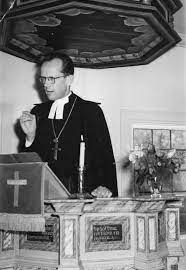
The other issue, once we get past language and differences, is publishing. Our majors publishers (Augsburg Fortress for ELCA, Concordia Publishing House for LCMS) each to my knowledge have only one work of his available (Hammer of God for Augsburg, To Live with Christ for CPH). This has kept Giertz out the main stream, especially in our church body. Is it any surprise that Hammer is often the only work of Giertz's many ELCA pastors are familiar with. One must go to a plethora of other smaller publishing houses to find his other works. Thankfully now we have a steady stream from 1517 publishing making one not have to go all over kingdom come to get his stuff. Their ongoing work with Bror Erickson means that as more people in the ELCA start discovering and shopping from this newer publishing house they may find more of his works. But it also means we need more advocating, promotion, and scholarship of his work in the ELCA. If we do, he can speak to another generation with his pastoral warmth and have a profound impact on more. 

I firmly believe I am a better pastor today because of my reading of Giertz. It's why I have taken up the cry for more to read him. And it's why I'm wondering why more have not yet taken up the cry in my church, and hoping that confronting some of the reasons doesn't discourage us, but rather allows us to move past them and understand that in spite of whatever has kept him a secret, he's our best kept secret. 

And it's time to spill the beans on this secret. For the sake of the church.

Monday, August 30, 2021

Armchair Book Review: With My Own Eyes

 
I've been on a bit of a review spree lately of Giertz books, since that was the focus of my summer reading. So I thought I'd throw another one out there by the good folks at 1517 Publishing: With My Own Eyes, a book that probably has potential to be the most popular of all of Giertz's works due to its broad Christian appeal. 

Regular readers of this blog need no introduction to Giertz, whom I have referenced with some regularity. For those who are newer, however, learn this name: Bo Giertz. He may be 20th Century Christianity's best kept secret. He grew up an atheist in a prominent Swedish family but came to faith later in life, went on to become a pastor, and eventually was elected bishop of the Gothenburg Diocese. Throughout his career and after he retired Giertz was a prolific writer, including several novels I have also recently reviewed (Faith Alone and Knights of Rhodes). 

What makes With My Own Eyes the most likely of his works to be enjoyed by a broad Christian audience is that it is based on something every Christian cares about: the life of Jesus. Simply put, this book is a novelization of the gospel stories. What Christian wouldn't have some level of interest in a story about the life of Jesus? Hence the wide appeal. But while the story covers something with a broad attraction, doing something that frankly has been done by many a Christian authors, here are some real strengths of Giertz's novel that not every book can boast about:

  • During his studies, Giertz secured an opportunity to excavate in the holy land for several months. Under the urging of his mentor, Anton Fridrichsen, he took regular walks throughout the land and detailed journals of all he saw. This allowed Giertz to describe the atmosphere in his book in vivid detail such that one is able all the more to gain a sense of the story. His descriptive style has earned him such comparisons as to my own mentor, the late great Walter Wangerin Jr., and while his descriptive style does differ from Walt's, it comes in the same living color.
  • Even though the story has plenty of content beyond the Gospels, it feels faithful to them. Rather he uses his knowledge of place and culture as well as the reflective thoughts of characters to expound without departing much from the story itself, especially in dialogue, and most especially in the dialogue of Jesus. Giertz has little interest in giving a new take to Jesus but rather in helping the reader make sense of the take the Gospel narratives give themselves. Only in one (maybe two) instance(s) can I think of the story having Jesus say words that are not in the scriptures. Anyone with a sense of a high level of authority of the scriptures should be able to appreciate that decision. 
  • Likewise, the book therefore never seeks to speculate into the secret thoughts of Christ himself. It always comes from the perspective of those who are watching, such that the reader might take in the Gospel "with my own eyes" (see what I did there?). The book does not stay with only one witness though. As I mentioned in my Rhodes review, this book (like Rhodes) is episodic. Giertz is not interested in telling a single, ongoing narrative but instead gives in each chapter a story about Jesus that together build and intertwine into the life of Christ. He doesn't seek to smooth out timelines or transitions, but instead gives us various opportunities as readers to glimpse his ministry through the eyes of various characters (disciples primarily). These different characters do give us some variation in viewpoint (although Giertz does not utilize this to maximum effect) but lots of reflection on what is going on. Here Giertz essentially gives the reader quality theological commentary on the gospels in a manner that especially highlights Anton Fridrichsen's concept of Biblical Realism (that the stories are rooted in actual event). By giving us the commentary in reflection one is constantly thinking about things in relation to the events around them (I should note, those wanting just plain old commentary will be able to get his commentaries on the gospels soon as they are being translated/published by 1517 publishing, the same company that brings us the new translation of With My Own Eyes, already his Romans commentary is available). 
  • The book does not try to cover only one gospel or everything in all four gospels. Instead, he selects a series of stories from across the gospels to focus on, but yet he also incorporates many more into other stories through the reflection/commentary, having the disciples process other events through whatever event they are witnessing. This gives a specially unique element of commentary in that it creates more interplay within gospel stories than one may have thought on their own. 
  • Another feature of the reflective commentary is that Giertz especially captures well a sense of simultaneous revelation and confusion. While constantly displaying what the disciples don't seem to grasp, he still shows pieces unfolding. Enough to make them stay with Jesus and have some sense about who he is, and enough to be totally aloof or make major foot-in-mouth statements. This juxtaposition is done here in a manner far better than I've ever seen elsewhere, where the disciples are usually more one dimensional (much more along the lines of totally faithful or totally ignorant, or extremely faithful here but totally ignorant there instead of this constant growth and humbling). This is seen best in relation to the kingdom of God. Giertz delivers many thoughtful comments through the reflections on all of Jesus' teachings and miracles related to the Kingdom, and yet it always feels elusive or just beyond their reach, beckoning them to follow him. It makes one understand why these men might have forsaken their lives to be his disciples.
As I noted above, this is a newer translation. There was a previous translation done some 50+ years ago that was not widely available, thus Bror Erickson sought to bring about a new one a couple years ago (he actually mentioned this in the comments on my blog post some years ago). I might actually commend that post to one who just wants a sneak peak into this book since there I translated the bulk of his chapter "Whiter Than Snow" (focusing on the story of the transfiguration). But do note that on this blog is my translation as opposed to Bror Erickson's. A reader of Bror's book will find his superior ability to translate into a more smooth English. Not only will his extensive experience in translating become apparent, but also why he is the one translating Giertz so prolifically for us today as he is extremely talented at the craft (and not just with Giertz or Swedish, I might add).

Simply put, With My Own Eyes is a well written, unique, and most of all faithful and inspiring novelization of the gospels. They are intended not to go where the Bible doesn't, but to widen our sense of understanding and appreciation for what we encounter in them. So long as one can appreciate its episodic style, the only real downside is the way the changing perspectives were perhaps a bit under-utilized. Otherwise, it is another one of his masterpieces in religious fiction.

Armchair Grade: A

Friday, August 27, 2021

Armchair Book Review: The Knights of Rhodes

 A book so nice once you've read it twice!


In my last post I reviewed the newest of Bo Giertz's novels available in English Faith Alone: The Heart of Everything, now allow me to review what might be his most distinctively different book available: The Knights of Rhodes.

Interestingly, Knights was one of the first things I ever read of Giertz's, because I got into Giertz just as we started getting a new wave of Giertz books available (many of which are now coming out via 1517 publishing thanks to the translational work of Bror Erickson, who also translated this book). Though not incredibly long, the book was not an easy read either. But that changed when I went back to reread it this summer.

Set in the time of the Reformation (1520's), the story features the siege of the island of Rhodes by Suleiman and its defense by the Knights Hospitallers. Giertz does extensive research in advance of this book and uses the very detailed notes found in records to form a narrative, which he then, as he is well able to do, manages to give life to these historical characters and bring the history off the page and into your imagination. People with an interest in medieval warfare or knowing more of the history of this time period will definitely appreciate this work and the hard work Giertz puts into finding all the right terminology and trying to present everything accurately. It truly is a masterpiece of historical fiction.

Those who love Giertz's other novels may find themselves a little disappointed in that Knights does not present in the same way as the other novels like Hammer of God or Faith Alone. It has an episodic style similar to that of With My Own Eyes, which I love. As I mentioned in my Faith Alone review, one of the few things I don't like about that novel or Hammer is the excessively long chapters. Knights on the other hand has very short chapters, but as I listened this week to the translator Bror Erickson say they are more like short stories that inform each other, I think the term episodic is a good way to put it. Kind of like watching a tv show like Lost where each episode tells its own story, but the story furthers the overall story and you learn more about the characters featured in that episode. That's kind of how the chapters of this book work. This is almost certainly a result of Giertz reconstructing from the records available which (as one can imagine) were themselves episodic. But because of that, it doesn't read quite like a normal book, which makes the reader a little unsure of why they feel unsure of what is all happening the first time they read it.

That is why I have to emphasize with this book what a difference it was to read the book again. Even though it had been 10 years since I last picked it up, this time around I had a much different handle on the book. The other thing I learned from the first time was that you really need to read the list of characters and terms that Giertz puts at the start of the book. Knowing how the episodic style jumps not only in story but in characters, it really makes a difference to study those first pages a bit so one is ready to read the story.

Now while I noted that those who are expecting something like Giertz's other novels might be disappointed, those wanting some theology will not be disappointed. However, Knights is far more subtle in its theological approach that any of Giertz's other novels. However, as Erickson notes in his words in the book, if Hammer of God is a wonderful work on Law and Gospel, Knights of Rhodes could be called his work on theology of the cross. Listening to him lay it out this week, he puts it well: the book pits two theologies of glory against one another, only to discover the theology of the cross as the true experience and way of it. And this in many ways is a parable for all of Western Christianity - how does one maintain hope and faith amidst heavy losses? Read this book to find out. There are moments in key relationships that highlight these dynamics and the interested reader would do well to keep on the lookout for it.

Yet, because the theology is so subtle, this book has a different appeal than his other ones. By not being "in-your-face" theologically, and the moments feeling like a natural part of the world and story, the subtle work here does not feel forced. Indeed, a person just with interest in the story could very well enjoy it even if they were not one to typically pick up religious fiction. Readers who want to engage Christian themes but don't like cheesy or forced Christian themes may very much enjoy this book. Likewise, it can be shared with those who have no interest in theology and perhaps plant a seed.

Of all his books, this one may be the least popular among circles that are fans of his other stuff, and yet also have potential to bring Giertz into circles that would never read his other stuff. The book should be commended therefore for its uniqueness among his works. But for that same reason some will not like it as much. This story though is a really gripping one, and if you don't know how it ends then you wonder how they will get through. And some never will. The overwhelming odds of the Turks against the men of Rhodes is reminiscent of the 300 Spartans against the great Persian Empire. And it shows just what a wonder it was for them to fight as hard as they did to hold this last stronghold of Christianity.

The difficulties that may require a double reading hold back top grade, but overall Giertz does it again with a compelling tale, profound moments, and emotional tragedies. I would definitely recommend the book (albeit with the warnings above): B

Saturday, July 3, 2021

Armchair Book Review - Faith Alone: The Heart of Everything

Did Bo Giertz write a better novel than Hammer of God?


That's kind of how I felt after reading Faith Alone: The Heart of Everything. The jury is still out on whether it is truly better (Hammer is on my reading list for this summer, so we'll see how I feel after a reread), but any fan of Giertz's most famous work (one of Sweden's all-time best sellers and without a doubt the most well known of his works available in English) should pick up the latest of his works brought into English by translator Bror Erickson (here's a quick link for your convenience). *Fun Fact: years ago Bror commented on my blog when I offered a rough translation of Giertz's transfiguration day chapter from With My Own Eyes, sharing his plans to make that work available in English again which he eventually did

Coming back to Faith Alone, the book features a lot of what I love (and even some of what I hate) from Hammer of God. Starting with the one big negative for me with both books is that they are kind of slow reads, and suffer from exceptionally long chapters. Indeed, though the book is 271 pages in length, it only features 6 chapters! I'm one who tends to like reading breaks, and I like to take them at good break points, chapters being my preferred book-mark. That really doesn't work here. In Giertz's defense, each chapter really works as a cohesive whole, usually happening in a single day. But UFF-DA. I remember having the same issue with Hammer. 

More positively, like Giertz's other masterpiece, Faith Alone features similar characters: main characters (including clergy) who still have much to discover of the law and gospel, pastors who are true Seelsorgers, people who practice extreme piety as a solution to the apparent faithlessness of the mainline church. In some ways, what happens is so familiar it is really the same story just told in a different context.

The context though is one of the gifts of Faith Alone, set in Sweden in the years 1542-43, the story unfolds in the early years of the Swedish Reformation. This context sets the story apart from Hammer especially in how alive Giertz makes it. The story follows two brothers, Anders/Andreas and Martin. One a devout Catholic priest, the other an evangelical (Lutheran) Scrivener for the king. Giertz does a masterful job of bringing these two brothers to life and showing in living color their respective faiths. And yet, as he has in Hammer, also showing what is lacking in these living faiths, namely, showing what is lacking when we try to give life to our own faith. Giertz's style of expressing the Christian life as spiritual impoverishment by which God's gospel can speak runs through this novel, particularly it's second half. It is that spiritual journey which makes this feel a lot like Hammer.

And yet those familiar with Giertz's novel The Knights of Rhodes will also find familiarities. Like Rhodes, this book is set in a specific historical context and also has themes that explore faith in the midst of ruin. Hammer of God has been said to be a great novel regarding Law and Gospel, while Knights of Rhodes explores Theology of the Cross. Faith Alone explores both. One might argue the others do a better job in their respective categories (Hammer has often been used as a seminary textbook even), but this book gives wonderfully explores both. It also is a wonderful book regarding the teaching of justification by faith alone (obviously) but also the Lutheran concept of Two Kingdoms. 

It is this two kingdoms element that also helps give life to the story. Set in the midst of a rebellion within the land, at times the two brothers are not only coming from different faith traditions, but also from different sides of the unrest (think brothers in an American Civil War context). Because of this, and because the story is ultimately about both brothers' spiritual discovery of the gospel, everything feels gray as it often does in life. You never have the "good guys" and "bad guys", you have two brothers caught up in a real mess where sin taints everything and it's not as simple as fight for the right side. In fact that is part of the point, it's never simply about the right side, deed, or correction. This grayness, and ability to show plainly and bluntly the characters (both main and supporting), without having to hold back any faults gives the book a distinct sense of reality you rarely find in novels.

Compared to past novels of Giertz brought to English, I must admit the editing on this first edition was poor and the reading experience suffered multiple times from noticeable mistakes. But there were also improvements. A former professor of mine, Mark Granquist, provides a helpful historical introduction that helps one have a better sense of Swedish history and where exactly you are in it when you open the book. Erickson also provides throughout the novel a series of footnotes when odd/unique Swedish terms are used, or to translate the Latin spoken/prayed. I found these footnotes helpful and inciteful. 

"Tron allena" is the Swedish title,
and translates to "Faith Alone"

I began by saying this book may be better than Hammer of God, and one of the things I especially liked more than Hammer was that this was one consistent story rather than three different novellas. The novellas in Hammer are their own kind of gift, allowing the book to cover more ways the gospel has been suppressed in the church. They also, by taking place in the same area over a stretch of years leave the churches as the tie throughout, a beautiful concept in its own right. Instead Giertz covers his variety of issues in Faith Alone by following two characters throughout the same events. This is I think more effective and familiar and invests you in the story more. He does a better job here of connecting you to the characters than in Rhodes by having far fewer characters overall. The story is also more compelling and interesting than in Hammer. And like Rhodes, it has parts that would appeal even to people uninterested in religious fiction (though Rhodes is better as a book for offering theology subtilty, as the title here suggests, there is a significant focus on matters of faith here). It's a story people would want to hear about. And this again helps invest you in the characters. As I've said over and over, the context of this story is one of its gifts.

As I have with Hammer, this book left me thinking about what contexts is could be used as a teaching tool. Confirmation? Reformation History? It's a very powerful way to express the heart of Lutheran theology and why in our theology faith alone is (as the title says) "The Heart of Everything".

Overall Grade: A+

Click here for a quick link to order Hammer of God

Tuesday, May 18, 2021

Baseball has a major offense problem

 Can we bring back steroids yet? Well, maybe that's not the best idea. But seriously, something has to be done. In general offense is down. Baseball has for a while become plagued with the 3 true outcomes: walk, strikeout, or a home run. It's part of what is making the game so boring to even long time fans. Well, that and dilly-dallying between pitches

Who's the culprit? You have Major League Baseball's not so brilliant idea to remove the most exciting of the 3 true outcomes by deadening the baseball. That seems to have worked, although it may also be the new seams on the ball possibly improving pitcher's grip as strikeouts have increased to historic rates.


It could also be some teams are just taking a bad approach at the plate this year. Take my Brewers for example who are taking a ton of pitches only to rank near the top in strike outs, near the bottom in slugging and OBP, and in the middle of the road in walks. That may be a wider trend. The Brewers are a case-in-point to a
In over half their games this year, the Brewers
or their opponents have scored 2 runs or less.
wider injury issue
in MLB this year which could also be a factor when lots of regulars are not in the line-up every day.

And then, of course, there is the fact that some teams (my Brewers included) have looked noticeably worse on offense since the Astros/Red Sox sign stealing scandal broke and MLB made clear the severity of its enforcement to any team that is caught. Could it be that the bigger issue is that this was a more common issue than we outside the industry realize?

I'm not sure. The truth is it probably is a combination of these. But something has to happen. Should it be moving the mound back? It would probably have the desired effect of more contact and in-game action. But what will it do to breaking pitches? I imagine things might get a little Colorado Rockies really fast.

All I know is that after a Covid-shortened season, this was not the year to deaden the ball. All I know is baseball is back and boring as ever. And I love baseball. I love pitching duels. But when it becomes the norm it doesn't work. The excitement of a pitcher's duel is when it's out of the ordinary. That the game seems turned on its head and instead of being about a team stringing together hits it becomes about two guys on the mound. That's awesome. But that's not what baseball should always be. Because once high strikeouts and 1-0 games are no longer special, they become slow and lack energy. It's an uneventful game instead of a testament to two guys rising above the game.

I'm a baseball hungry fan, who felt starved last year like never before. Somebody start feeding me runs please.

But not artificial ones either. Yes I'm talking about the new runner on second extra inning rule. Anecdotally it doesn't seem to me to be helping speed up extra inning games. But it also feels like a genuine manipulation of the game itself. I hate-hate-hate the rule. Much like I hate-hate-hate 7-inning double headers (though I understand why we have them in the days of Covid, but please take them away next year). Seems pretty sucky that we'll never know if Madison Bungardner would've finished a no-no.

The point is it's hard to say what is killing the game faster: the way it's played or the rules that are meant to manipulate how it is currently being played. It means baseball has a real problem, and it might take more than a rule change to fix it. 

But please, please, fix it soon!


Wednesday, March 31, 2021

2021 MLB Predictions


Alright readers, we are on the cusp of a new season of baseball! After the unfortunate shortened season of 2020 it's time for 2021 and a return to some more normalcy. And with a new CBA around the corner there are ill omens of a possible work stoppage in baseball's future so let's really enjoy this season (can I get an "amen"?).

AL West: 

  1. Oakland Athletics: I've doubted them for too long. This team is better than it looks. They've performed in a very consistent winning percentage the last couple years, and have a star in Matt Chapman with some solid pieces to compliment. I also like the upside of the pitchers.
  2. Los Angeles Angels: With Rendon and Trout the floor is gonna be low. The only question is if they can ever piece together a group around them. I'm confident enough, especially with the decreased quality of the division that they have a better shot this year.
  3. Houston Astros: A lot will depend on how well their hitters - particularly their infielders - will rebound. More upside to this team than any other. But losing Verlander is a huge blow. I like the Odorrizi singing. 
  4. Seattle Mariners: This team has a lot of unproven talent and could one year surprise and put it all together. They have some of baseball's best prospects plus reigning ROY Kyle Lewis, so things are looking up. But I think we're still at least a year away from being in the upper half of this division.
  5. Texas Rangers: Sorry to say this looks like a sad state team. They look worse than they did before (yikes), although I think Kris Davis may have a big rebound year for them. I hope so, I've always been a huge fan. Joey Gallo is as good of a 3 true outcome player as there is.
AL Central:
  1. Minnesota Twins: They've been real strong for three of the last four years. They're young and talented and still got some team depth and payroll flexibility. Maeda is probably in for some regression, but he's still good (I always thought it was crazy that LA would not start him more). They're gonna miss Rosario. And if Donaldson and Cruz show their age things could be much worse than it looks.
  2. Chicago White Sox: Before Eloy's injury I had them as first in the division. They have a really talented team and it is really young with room to be even better. I really like the team that's been constructed. But depth could be an issue.
  3. Kansas City Royals: I'm betting on the Royals bucking the system once again. This is a team that dances to its own tune in baseball and has succeeded by doing so. I really liked their offseason. It wasn't ridiculous, it wasn't loaded with expectations, but it quietly improved a quality (if unspectacular) young team. The rotation will be an issue.
  4. Cleveland Indians: So I'm taking a risk and predicting this team will not keep over-performing. The Indians have managed to be relevant for years. But I think the Lindor dud of a trade will really bite them, especially since they shipped Carrasco with him. They somehow always have the pitching no matter who is gone, but I think they will be sorry. Bieber is a beast though and Ramirez is under-rated by fans.
  5. Detroit Tigers: Still a basement team, but man they might be the White Sox in a few years. Here's to hoping Miggy has a good year. He could reach 3k hits and 500 home runs this season! I'm glad Hinch was hired as their manager, he did not deserve to be out of baseball forever with the Houston sign stealing scandal since all reports indicate he knew about it but was unhappy with it. He should be a good fit for this team.
AL East:
  1. New York Yankees: Injuries are a concern, this team has a lot of volatility because of it. But they are still the Yankees and I'm a believer in the rotation's upside. Loved the LeMahieu deal for them. They may be running out of years where they are in the top 2 of this division. But Cashman knows how to GM this team well, and there is some solid depth to go with the oft injured star power.
  2. Toronto Blue Jays: An excellent line up with a solid if unspectacular rotation (especially after Ryu). This team reminds me of some of the past Yankees teams, and like them, I imagine they will be in contention if not the playoffs.
  3. Tampa Rays: Losing Snell is going to hurt. Though like the Indians and A's, this team has played better than they should and is a sum of its parts. Still, their method of trading stars while still in the realm of contention is a dangerous gamble and I'm betting against them.
  4. Boston Red Sox: Kind of a team stuck in transition. They don't strike me as good enough to take the division, though they could be in contention by the break. But more likely they look like a team ready to sell off more parts at the trade deadline to restock a depleted farm system.
  5. Baltimore Orioles: Not a lot of hope for this current roster. Especially since some of its legit performers like Mancini will very likely be traded at the deadline. The pitching may be unproven, but there is some talent there and I expect at least one breakout this season, though this team has been really bad for sometime in developing talented pitchers into quality major leaguers (as evidenced by the success so many of these guys have found after leaving Baltimore).
AL Wild Cards: Toronto and Chicago. More complete teams than the other options. Both have a strong chance to take their own divisions so I'll pick them. 

NL West:
  1. Los Angeles Dodgers: They are deep and talented. Winds of change may be coming in regards to who is king on the West, but not this year. Bauer is a wild card, he could be an ace or he could be just good. Bellinger will be a beast again. This team is strong in every facet of the game and resourceful in prospects and cash.
  2. San Diego Padres: I would be expecting some regression except that Preller put the pedal to the metal and really strengthened an already good team this offseason. To think he was able to do that and still maintain several of baseball's top prospects is amazing. Tatis is the most exciting player in baseball and plays a premium position. I expect Darvish to regress some, but he's still a clear upgrade. Musgrove, though he came with the least fanfare, may be the most surprising improvement. He had a career year last year and is 28. 
  3. Arizona Diamondbacks: This team is probably better than they were in 2020 but worse than they were in 2019. But the team is solid not spectacular and has more chance to fail than exceed expectations.
  4. San Francisco Giants: This team could build off of last year and actually be a winner (not contender, but on the right side of .500), but Longoria, Belt, Posey, Dickerson, and Crawford are all a year older and the rotation isn't formidable. So I'm betting against.
  5. Colorado Rockies: Sold low on Arenado, will almost certainly sell off Story before season end, and the good pitchers of a few years ago are looking as susceptible to Coors air as we've grown acustomed to. 
NL Central:
  1. Chicago Cubs: I know they had a terrible offseason, and their rotation took a huge hit, but they were good even when their core guys were awful last year. Hendricks is an unconventional ace, but still an ace, and I think Davis may continue last year's success if he can learn from Hendricks who is a similar pitcher. The Cubs are bucking the system by not relying on hard throwers, but it may work. Whatever concern there is over Bryant, Baez, and Rizzo's 2020 (and there is real reason for concern when you look under the hood), there is more reason to believe they will rebound. I'd still take this line-up over any other in the division.
  2. Milwaukee Brewers: This team has a lot of ifs attached to it, but the biggest if (if Yelich will return to form) is quite likely given his hard hit rate last year and his huge spring. They also have a lot of versatility and a manager who handles that well to plug some holes. I would've felt more comfortable if someone from Urias, Shaw, and Arcia had a good spring. The left side of the infield is still a hole. But they have as good a 1-2 punch in the rotation and bullpen as anyone in the division. A lot of talk about Burnes and Woodruff, but I think Peralta is going to be the revelation this year. 
  3. St. Louis Cardinals: I know a lot of folks are picking them to win the division after picking up Arenado, but I think this team has some serious questions in the rotation and line up. They probably have higher upside than any team in the division, but unless Nolan and Goldschmidt return to peak form, I have some serious concerns. Defense is still strong - even without Wong - and the bullpen is underrated. 
  4. Cincinnati Reds: Any one of these four teams could realistically win the division, but the poor defense and poor offseason makes it hard to pick this team ahead of the rest. They have a lower floor. But Castillo and Gray are a strong duo in the rotation, and a return to hitting pitchers makes Lorenzen a greater asset. 
  5. Pittsburg Pirates: This team had a narrow window of success, offset by the fact they never were the best team in the division, and tight coin purses and poor front office management destroyed any chance of success. To call their method tanking would imply their failure will improve their team. Hard to tell with the Pirates. Easy pick in an otherwise difficult division to judge.
NL East:
  1. Atlanta Braves: This team has a lot in common with the Padres and White Sox: well stacked with young talent, complimented with other pieces, oh, and they have the reigning MVP in Freddie Freeman and he may not even be their best player, especially if Acuna continues to grow (which given his age is entirely plausible). Their success will likely depend on the health of the rotation and the effectiveness of the bullpen as that's where my biggest concerns lie.
  2. New York Mets: This is a strong team. Like the White Sox I have some depth questions, but they have a lot of imposing bats, probably the best pitcher in the game right now in deGrom, and made an underrated pickup in McCann at catcher. As imposing as they are, they still are without Thor who will be returning to them midseason. A strong return to form by Lindor (which is a reasonable ask) will go a long way. One more solid addition this offseason probably would have made them division favorites. 
  3. Miami Marlins: Call me crazy, but I'm predicting another step forward for the team whose 2020 playoff birth was written off more than any other. With a return to the old playoff format I don't expect them to make the playoffs, but I think another winning season is probable. They did not suffer a horrible loss in the offseason and have an underrated rotation, and they have Sixto Sanchez in the wings. The biggest question mark is the line-up, which hardly inspires. But along with the Royals, this is my dark horse team for 2021. 
  4. Washington Nationals: This team feels like the National League's version of the Angels in their inability to form a complete team around elite players. They have perhaps the greatest hitter in baseball in Soto, who is still just 21 years old! His patience reminds many of Barry Bonds, his rapidly increasing skill into the top Escalon reminds me of Miguel Cabrera. Add to that Trea Turner, who may be one of the most unappreciated players in baseball (not because he's not a star, just not recognized for how big a one he is) and this team should be a top the division. But Strasburg cannot be counted on for a full season, Scherzer is 37 and finally showing it. Corbin gets by more than he should and the rest of the team looks like spare parts. That makes this team hard to predict. They should be better than at least the Marlins, but I'm gonna predict a Red Soxesque fall from World Series to irrelevance in 2 years.
  5. Philadelphia Phillies: In what way is this team better than the team that has hovered around .500 the last few years? More of the same, but a year older. Add to that the upward trajectory of other teams in this division and they make my pick for last in another tough division. Though I admit the Marlins could be in this spot.
NL Wild Cards: Padres and Mets. The second Wild Card is hard to predict. The NL Central though feels like such a competitive division (not counting the Pirates) that whoever comes in second is not likely to be as good in the standings as the number two teams in the West and East.

Playoffs:
Wildcard Games: the one thing I will miss from 2020 was the expanded playoffs, most importantly the fact that we had more than a one and done series. The Padres are in my view the better team, but in a one game playoff I'm taking the team that can put deGrom on the mound. Mets over Padres.

In the AL I'm gonna return to my big pick from last year and go with the Blue Jays over White Sox. If the Sox won the Central, I might pick them for the World Series, but in a one game playoff Ryu can match Giolito but the Jays have the more electric line-up. 

Division Series: Yankees over Twins. Until they can show they are able to win a playoff game (especially against the Yankees whom they've lost 16 consecutive playoff games against) I'm not betting on the Twins, no matter how good they are. Meanwhile I will keep my prediction of the Blue Jays strong as I pick them to defeat whatever the West throws at them. So we'll say Jays over A's.

Dodgers over Mets: If they didn't have to use deGrom in a Wild Card play-in maybe I'd go Mets, but he might not get to pitch twice in this best-of-five series, so I'll go with the reigning World Series champs. Meanwhile the Braves will mark the end of the Cubs dreams of a dynasty team. Braves over Cubs.

Championship Series: The Blue Jays are the kind of line up that reminds me of the Royals during their back-to-back World Series years: able to make a rally at any moment. A big inning team. But the Bronx Bombers are a serious power threat and have the better rotation (if healthy) and a shut-down bullpen (if healthy). So I'll take them, but assume it will be a close series. In the end though, Yankees over Blue Jays.

If for nothing but spite alone, I will again vote against the Dodgers even though they have the best team in baseball and are coming off a World Series victory. I have no good reason except that spite and belief that the Braves may be better than we've seen to date and have more motivation to improve at the deadline than the Dodgers who with their World Series victory in hand have less reason to bet the farm. So a rematch of the '96 and '98 World Series will be in order as I select the Braves over Dodgers.

World Series: I would love to see both of these teams return to the big stage. Who do I pick? While I would want history to repeat itself and see my Yankees reclaim their title for the first time in over a decade, I'm gonna imagine that beating the best team in baseball fuels the Braves to write a new chapter in the history of these team's face-offs with a World Series victory going to Atlanta over New York.

Awards:
NL MVP: Manny Machado. I first picked Soto, so he's my main backup. Arenado could win it with a big year. Yelich will probably be back in the top 5. As could the likes of Betts, Tatis, Acuna, Bellinger, Seager, and Freeman. But Machado's mashing may have easily been missed last year in a shortened season. Over 162 games he would've hit .304/.370/.580 with 43 homers and 16 stolen bases. The Padres are likely to get more attention this year too, which will help him make his case. My dark horse candidate will be Eugenio Suarez.

AL MVP: Mike Trout. Why bet against him when you know he's gonna be in the top 5 right? It's crazy to think that Ohtani and Rendon could also be candidates and yet the Angels are still a fringe contender. Jose Ramirez is my main back up though. Don't forget about Bregman. My dark horse is (if you can call him that) is DJ LeMahieu.

NL Cy Young: Jacob deGrom. I used to always pick Kershaw, now it's deGrom. The guy just keeps getting better. I expect guys like Buehler, Snell, and Flaherty to be in the race. Don't be surprised if Corbin Burnes is in the race too. But my dark horse is Julio Urias.

AL Cy Young: Shane Bieber. He led the AL in WAR, ERA, K's, and k/9 (among starters) and was second in WHIP and innings pitched. Plus he pitches in an underwhelming division. So I'm going to go with him. Giolito is my back up after he showed last year that he is a true ace. My dark horse is Jesus Luzardo.

NL ROY: Ke'Bryan Hayes. Hayes has several things going for him: he has a high floor because of his great defense, and he plays for a non-contender that has no reason to bench him if he goes through a slump which gives him a chance to play out a full season worth of counting stats. But add to that his explosion on the scene last year (which exceeded expectations) and there is reason to believe he will be the Pirate's best player, which could earn him an All Star selection and garner more national attention needed to be voted top rookie. Just to show how good he is: this guy produced 1.9 WAR in just 24 games last year! My backup is Ian Anderson. Dylan Carlson and Christian Pache will probably be in the conversation too. As a dark horse, MacKenzie Gore will probably be a part of the Padres' success this year.

AL ROY: Bobby Witt Jr. He had a huge spring and is probably just waiting for service time manipulation date to be called up. Andrew Vaughn will probably be in the conversation and has the advantage of making the opening day roster (kudos to the Sox for putting the best product out on the field from day 1). A lot of folks are picking Randy Arozarena, and I don't imagine it will be long before we see Jarred Kelenic. My dark horse is Casey Mize who made the Tiger's roster.

NL Manager of the Year: Craig Counsel. CC is bound to win this award at some point. This is an ideal year for unorthodox managing of pitching, and no one may do that as well as CC. David Ross, Brian Snitker and Jayce Tingler will be considered if they make playoffs. Dave Martinez is a perennial candidate. My dark horse is Don Mattingly.

AL Manager of the Year: Joe Maddon. He has the name recognition, and if he can finally get the Angels at least close to the playoffs he'll probably be rewarded for not mismanaging that team. Boone, Montoyo, and La Russa stand out as real possibilities. Dusty Baker will deserve it if the Astros put things together. Don't sleep on Terry Francona, he's my sleeper candidate (if you can call him that).

NL Comeback player of the year: Christian Yelich. There are a lot of options after 2020 had so many players off. Bellinger and Arenado come to mind. Bryant, Rizzo, and Baez too. But Yelich seems the most likely to not only bounce back but climb to even greater heights. For a dark horse, Tommy Pham, since he's not as recognizable as the other names here.

AL Comeback player of the year: Trey Mancini. The guy didn't get to play last year, and his return to baseball is a triumph alone. Which means he has the people's hearts. His isn't a comeback from underperformance, but from health issues. Plus he may be dealt to a contender midseason and help push a team over the edge. JD Martinez and Andrew Benintendi also make sense on this list. As do Altuve, Correa, and Bregman. For a dark horse, let's wrap this post up by going with my boy Kris Davis. 

That's all, hope you enjoyed this. Hope I'm right!